Ch. 3 - Derivatives
Briggs - Calculus: Early Transcendentals 3rd Edition
Briggs3rd EditionCalculus: Early TranscendentalsISBN: 9780136847243Not the one you use?Change textbook
Chapter 3, Problem 3.9.22

Find the derivative of the following functions.
y = In √x⁴+x²

Verified step by step guidance
1
Step 1: Recognize that the function y = ln(√(x⁴ + x²)) can be rewritten using properties of logarithms and exponents. The square root can be expressed as a power of 1/2, so rewrite the function as y = ln((x⁴ + x²)^(1/2)).
Step 2: Apply the logarithmic identity ln(a^b) = b * ln(a) to simplify the expression. This gives y = (1/2) * ln(x⁴ + x²).
Step 3: Differentiate the function using the chain rule. The derivative of y with respect to x is dy/dx = (1/2) * d/dx[ln(x⁴ + x²)].
Step 4: Use the derivative of the natural logarithm function, which is d/dx[ln(u)] = (1/u) * du/dx, where u = x⁴ + x². First, find du/dx, which is the derivative of x⁴ + x² with respect to x.
Step 5: Calculate du/dx by differentiating each term separately: the derivative of x⁴ is 4x³ and the derivative of x² is 2x. Therefore, du/dx = 4x³ + 2x. Substitute this back into the expression for dy/dx to complete the differentiation process.

Verified video answer for a similar problem:

This video solution was recommended by our tutors as helpful for the problem above.
Video duration:
7m
Was this helpful?

Key Concepts

Here are the essential concepts you must grasp in order to answer the question correctly.

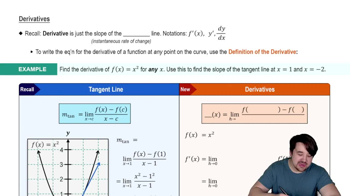
Derivative

The derivative of a function measures how the function's output value changes as its input value changes. It is a fundamental concept in calculus, representing the slope of the tangent line to the curve of the function at any given point. The derivative is denoted as f'(x) or dy/dx and can be calculated using various rules such as the power rule, product rule, and chain rule.
Recommended video:
05:44
Derivatives

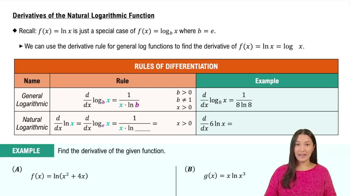
Natural Logarithm

The natural logarithm, denoted as ln, is the logarithm to the base e, where e is approximately equal to 2.71828. It is an important function in calculus, particularly in integration and differentiation. The natural logarithm has unique properties, such as ln(ab) = ln(a) + ln(b) and ln(a^b) = b*ln(a), which are useful when simplifying expressions before taking derivatives.
Recommended video:
05:18
Derivative of the Natural Logarithmic Function

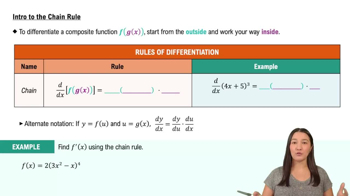
Chain Rule

The chain rule is a fundamental technique in calculus used to differentiate composite functions. It states that if a function y is composed of two functions u and x (i.e., y = f(u) and u = g(x)), then the derivative of y with respect to x can be found by multiplying the derivative of f with respect to u by the derivative of g with respect to x. This rule is essential for handling functions that are nested within one another.
Recommended video:
05:02
Intro to the Chain Rule