Ch. 3 - Derivatives
Briggs - Calculus: Early Transcendentals 3rd Edition
Briggs3rd EditionCalculus: Early TranscendentalsISBN: 9780136847243Not the one you use?Change textbook
Chapter 3, Problem 3.9.31

Find the derivative of the following functions.
y = In x / (In x + 1)

Verified step by step guidance
1
Step 1: Identify the function y = \( \frac{\ln(x)}{\ln(x) + 1} \). This is a quotient of two functions, so we will use the Quotient Rule to find the derivative.
Step 2: Recall the Quotient Rule for derivatives, which states that if you have a function \( y = \frac{u}{v} \), then the derivative \( y' = \frac{u'v - uv'}{v^2} \). Here, \( u = \ln(x) \) and \( v = \ln(x) + 1 \).
Step 3: Find the derivative of \( u = \ln(x) \). The derivative \( u' = \frac{1}{x} \).
Step 4: Find the derivative of \( v = \ln(x) + 1 \). The derivative \( v' = \frac{1}{x} \) since the derivative of a constant is zero.
Step 5: Substitute \( u' \), \( u \), \( v' \), and \( v \) into the Quotient Rule formula: \( y' = \frac{\left(\frac{1}{x}\right)(\ln(x) + 1) - (\ln(x))\left(\frac{1}{x}\right)}{(\ln(x) + 1)^2} \). Simplify the expression to find the derivative.

Verified video answer for a similar problem:

This video solution was recommended by our tutors as helpful for the problem above.
Video duration:
7m
Was this helpful?

Key Concepts

Here are the essential concepts you must grasp in order to answer the question correctly.

Derivative

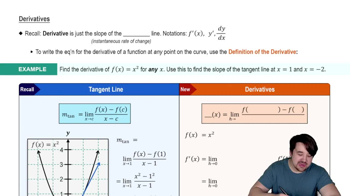
The derivative of a function measures how the function's output value changes as its input value changes. It is a fundamental concept in calculus that provides the slope of the tangent line to the curve at any given point. The derivative is often denoted as f'(x) or dy/dx, and it can be calculated using various rules, such as the power rule, product rule, and quotient rule.
Recommended video:
05:44
Derivatives

Quotient Rule

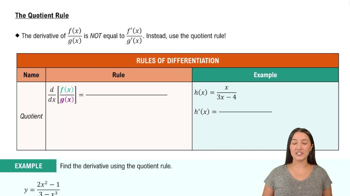
The quotient rule is a formula used to find the derivative of a function that is the ratio of two other functions. If you have a function y = u/v, where u and v are both differentiable functions of x, the derivative is given by y' = (v * u' - u * v') / v^2. This rule is essential for differentiating functions where one function is divided by another, as seen in the given problem.
Recommended video:
06:43
The Quotient Rule

Natural Logarithm

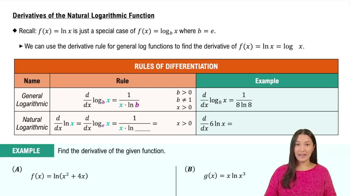
The natural logarithm, denoted as ln(x), is the logarithm to the base e, where e is approximately equal to 2.71828. It is a key function in calculus, particularly in differentiation and integration. The derivative of ln(x) is 1/x, which is crucial when differentiating functions that involve natural logarithms, as in the provided function y = ln(x) / (ln(x) + 1).
Recommended video:
05:18
Derivative of the Natural Logarithmic Function