Ch. 3 - Derivatives
Briggs - Calculus: Early Transcendentals 3rd Edition
Briggs3rd EditionCalculus: Early TranscendentalsISBN: 9780136847243Not the one you use?Change textbook
Chapter 3, Problem 3.7.25e

Derivatives using tables Let h(x)=f(g(x))h(x)=f(g(x)) and p(x)=g(f(x))p(x)=g(f(x)). Use the table to compute the following derivatives.
<IMAGE>
e. h(5)h^{\(\prime\)}\(\left\)(5\(\right\))

Verified step by step guidance
1
Identify the function composition: h(x) = f(g(x)). This is a composition of functions where f is the outer function and g is the inner function.
Recall the chain rule for derivatives, which states that if you have a composition of functions h(x) = f(g(x)), then the derivative h'(x) is given by h'(x) = f'(g(x)) * g'(x).
To find h'(5), substitute x = 5 into the chain rule formula: h'(5) = f'(g(5)) * g'(5).
Use the table to find the values of g(5) and g'(5). Substitute these values into the expression for h'(5).
Next, use the table to find the value of f' at the point g(5). Substitute this value into the expression for h'(5) to complete the calculation.

Verified video answer for a similar problem:

This video solution was recommended by our tutors as helpful for the problem above.
Video duration:
2m
Was this helpful?

Key Concepts

Here are the essential concepts you must grasp in order to answer the question correctly.

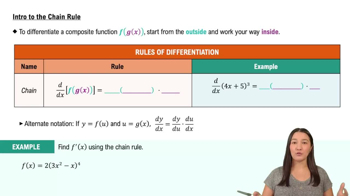
Chain Rule

The Chain Rule is a fundamental theorem in calculus used to differentiate composite functions. It states that if a function h(x) is composed of two functions, f(g(x)), the derivative h'(x) can be found by multiplying the derivative of the outer function f with the derivative of the inner function g. Mathematically, this is expressed as h'(x) = f'(g(x)) * g'(x). Understanding this rule is essential for solving problems involving derivatives of composite functions.
Recommended video:
05:02
Intro to the Chain Rule

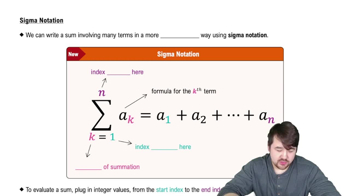
Derivative Notation

Derivative notation, such as h'(x) or f'(x), represents the rate of change of a function with respect to its variable. It indicates how the function's output changes as its input changes. In the context of the question, h'(5) specifically refers to the derivative of the function h evaluated at x = 5. Familiarity with this notation is crucial for interpreting and calculating derivatives correctly.
Recommended video:
04:22
Sigma Notation

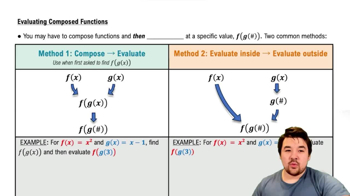
Function Evaluation

Function evaluation involves substituting a specific value into a function to determine its output. In the context of derivatives, evaluating functions at particular points, such as h(5) or g(f(5)), is necessary to compute the derivative using the Chain Rule. This concept is vital for applying the derivatives obtained from the Chain Rule to find specific values, which is often required in calculus problems.
Recommended video:
4:26
Evaluating Composed Functions
Related Practice
Textbook Question

Witch of Agnesi Let y(x²+4)=8 (see figure). <IMAGE>

d. Verify that the results of parts (a) and (c) are consistent.

Textbook Question

97–100. Logistic growth Scientists often use the logistic growth function P(t) = P₀K / P₀+(K−P₀)e^−r₀t to model population growth, where P₀ is the initial population at time t=0, K is the carrying capacity, and r₀ is the base growth rate. The carrying capacity is a theoretical upper bound on the total population that the surrounding environment can support. The figure shows the sigmoid (S-shaped) curve associated with a typical logistic model. <IMAGE>


{Use of Tech} Gone fishing When a reservoir is created by a new dam, 50 fish are introduced into the reservoir, which has an estimated carrying capacity of 8000 fish. A logistic model of the fish population is P(t) = 400,000 / 50+7950e^−0.5t, where t is measured in years.


d. Graph P' and use the graph to estimate the year in which the population is growing fastest. 

Textbook Question

The table gives the position s(t)of an object moving along a line at time t, over a two-second interval. Find the average velocity of the object over the following intervals. <IMAGE>


a. [0,2][0, 2]

Textbook Question

Derivatives using tables Let h(x)=f(g(x))h(x)=f(g(x)) and p(x)=g(f(x))p(x)=g(f(x)). Use the table to compute the following derivatives.

<IMAGE>

d. p(2)p^{\(\prime\)}\(\left\)(2\(\right\))

2
views
Textbook Question

A rectangular swimming pool 10 ft wide by 20 ft long and of uniform depth is being filled with water.

b. At what rate is the volume of the water increasing if the water level is rising at 1/4ft/min.

Textbook Question

Let f(x) = sin x. What is the value of f′(π)?