Ch. 3 - Derivatives
Briggs - Calculus: Early Transcendentals 3rd Edition
Briggs3rd EditionCalculus: Early TranscendentalsISBN: 9780136847243Not the one you use?Change textbook
Chapter 3, Problem 78

Derivatives from a graph Let F = f + g and G = 3f - g, where the graphs of f and g are shown in the figure. Find the following derivatives. <IMAGE>
F'(2)

Verified step by step guidance
1
Step 1: Understand the problem. We need to find the derivative of the function F at x = 2, where F = f + g. This means we need to find F'(2).
Step 2: Use the linearity of derivatives. The derivative of a sum is the sum of the derivatives. Therefore, F'(x) = f'(x) + g'(x).
Step 3: Evaluate the derivatives at x = 2. We need to find f'(2) and g'(2) from the graph of f and g.
Step 4: Analyze the graph. Look at the slope of the tangent line to the graph of f at x = 2 to find f'(2), and do the same for g to find g'(2).
Step 5: Substitute the values. Once you have f'(2) and g'(2), substitute them into the equation F'(2) = f'(2) + g'(2) to find the derivative of F at x = 2.

Verified video answer for a similar problem:

This video solution was recommended by our tutors as helpful for the problem above.
Video duration:
5m
Was this helpful?

Key Concepts

Here are the essential concepts you must grasp in order to answer the question correctly.

Derivative

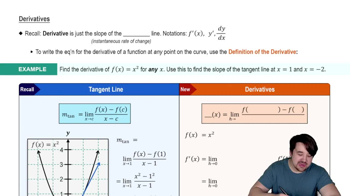
A derivative represents the rate of change of a function with respect to its variable. It is defined as the limit of the average rate of change of the function as the interval approaches zero. In graphical terms, the derivative at a point corresponds to the slope of the tangent line to the curve at that point.
Recommended video:
05:44
Derivatives

Sum and Difference of Functions

When dealing with the sum or difference of two functions, the derivative can be computed using the sum and difference rules. Specifically, if F = f + g, then F' = f' + g', and for G = 3f - g, G' = 3f' - g'. This allows us to find the derivatives of composite functions by differentiating each component separately.
Recommended video:
06:11
Introduction to Riemann Sums

Evaluating Derivatives at Specific Points

To find the derivative at a specific point, such as F'(2), one must first compute the derivative function and then substitute the given value into this function. This process often involves analyzing the graphs of the functions involved to determine their slopes at the specified x-value, which can be visually interpreted from the graph.
Recommended video:
04:50
Critical Points