Ch. 3 - Derivatives
Briggs - Calculus: Early Transcendentals 3rd Edition
Briggs3rd EditionCalculus: Early TranscendentalsISBN: 9780136847243Not the one you use?Change textbook
Chapter 3, Problem 3.4.49

Derivatives Find and simplify the derivative of the following functions.
g(w) = √w+w / √w-w

Verified step by step guidance
1
Step 1: Rewrite the function \( g(w) = \frac{\sqrt{w} + w}{\sqrt{w} - w} \) in a form that is easier to differentiate. Consider using the quotient rule, which states that if you have a function \( \frac{u}{v} \), its derivative is \( \frac{u'v - uv'}{v^2} \).
Step 2: Identify \( u = \sqrt{w} + w \) and \( v = \sqrt{w} - w \). Find the derivatives \( u' \) and \( v' \). For \( u = \sqrt{w} + w \), use the derivative rules: \( u' = \frac{1}{2\sqrt{w}} + 1 \). For \( v = \sqrt{w} - w \), use: \( v' = \frac{1}{2\sqrt{w}} - 1 \).
Step 3: Apply the quotient rule: \( g'(w) = \frac{(\frac{1}{2\sqrt{w}} + 1)(\sqrt{w} - w) - (\sqrt{w} + w)(\frac{1}{2\sqrt{w}} - 1)}{(\sqrt{w} - w)^2} \).
Step 4: Simplify the expression in the numerator by distributing and combining like terms. Carefully expand each term and simplify.
Step 5: Simplify the entire expression by combining like terms and reducing the fraction if possible. Ensure that the final expression is in its simplest form.

Verified video answer for a similar problem:

This video solution was recommended by our tutors as helpful for the problem above.
Video duration:
6m
Was this helpful?

Key Concepts

Here are the essential concepts you must grasp in order to answer the question correctly.

Derivatives

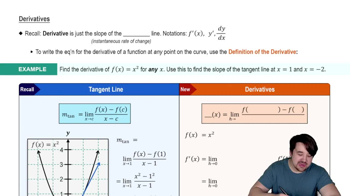
A derivative represents the rate at which a function changes at a given point. It is defined as the limit of the average rate of change of the function as the interval approaches zero. In calculus, derivatives are used to find slopes of tangent lines, optimize functions, and analyze motion. The notation for the derivative of a function f is often written as f'(x) or df/dx.
Recommended video:
05:44
Derivatives

Quotient Rule

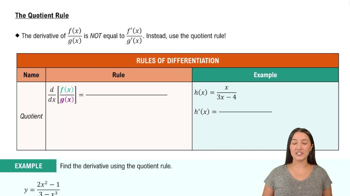
The Quotient Rule is a method for finding the derivative of a function that is the ratio of two other functions. If you have a function h(x) = f(x)/g(x), the derivative h'(x) is given by (g(x)f'(x) - f(x)g'(x)) / (g(x))^2. This rule is essential when differentiating functions that involve division, ensuring that both the numerator and denominator are correctly accounted for in the derivative.
Recommended video:
06:43
The Quotient Rule

Simplification of Derivatives

Simplifying derivatives involves reducing the expression to its simplest form after differentiation. This can include factoring, canceling common terms, or combining like terms. Simplification is crucial for making the derivative easier to interpret and use in further calculations, such as finding critical points or analyzing the behavior of the function.
Recommended video:
05:44
Derivatives