
Ch. 3 - Derivatives
Briggs - Calculus: Early Transcendentals 3rd Edition
Briggs3rd EditionCalculus: Early TranscendentalsISBN: 9780136847243Not the one you use?Change textbook
Chapter 3, Problem 3.4.41

Derivatives Find and simplify the derivative of the following functions.
g(t) = 3t² + 6/t⁷

Verified step by step guidance
1
Step 1: Identify the function components. The function is g(t) = 3t^2 + 6/t^7. It consists of two terms: 3t^2 and 6/t^7.
Step 2: Rewrite the function for easier differentiation. The term 6/t^7 can be rewritten using negative exponents as 6t^(-7). So, g(t) = 3t^2 + 6t^(-7).
Step 3: Differentiate each term separately. Use the power rule for differentiation, which states that the derivative of t^n is n*t^(n-1).
Step 4: Apply the power rule to the first term. The derivative of 3t^2 is 2*3*t^(2-1) = 6t.
Step 5: Apply the power rule to the second term. The derivative of 6t^(-7) is -7*6*t^(-7-1) = -42t^(-8).

Verified video answer for a similar problem:

This video solution was recommended by our tutors as helpful for the problem above.
Video duration:
4m
Was this helpful?

Key Concepts

Here are the essential concepts you must grasp in order to answer the question correctly.

Derivatives

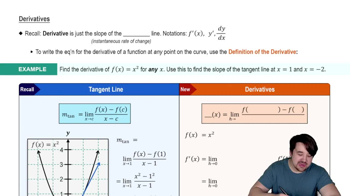
A derivative represents the rate of change of a function with respect to its variable. It is a fundamental concept in calculus that allows us to determine how a function behaves at any given point. The derivative is often denoted as f'(x) or df/dx, and it can be interpreted as the slope of the tangent line to the curve of the function at a specific point.
Recommended video:
05:44
Derivatives

Power Rule

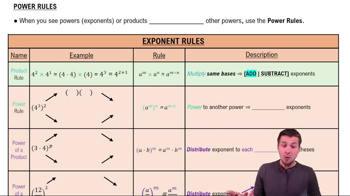
The Power Rule is a basic differentiation rule used to find the derivative of functions in the form of x^n, where n is a real number. According to this rule, the derivative of x^n is n*x^(n-1). This rule simplifies the process of differentiation, especially for polynomial functions, making it easier to compute derivatives quickly.
Recommended video:

Quotient Rule

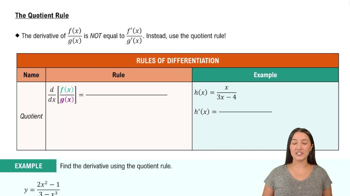
The Quotient Rule is a method for differentiating functions that are expressed as the ratio of two other functions. If a function is defined as f(x) = u(x)/v(x), where both u and v are differentiable, the derivative is given by (v*u' - u*v')/v². This rule is essential when dealing with rational functions, allowing for the correct computation of their derivatives.
Recommended video:
06:43
The Quotient Rule
Related Practice
Textbook Question

Orthogonal trajectories Two curves are orthogonal to each other if their tangent lines are perpendicular at each point of intersection (recall that two lines are perpendicular to each other if their slopes are negative reciprocals). A family of curves forms orthogonal trajectories with another family of curves if each curve in one family is orthogonal to each curve in the other family. For example, the parabolas y = cx² form orthogonal trajectories with the family of ellipses x²+2y² = k, where c and k are constants (see figure).

Find dy/dx for each equation of the following pairs. Use the derivatives to explain why the families of curves form orthogonal trajectories. <IMAGE>


y = cx²; x²+2y² = k, where c and k are constants

Textbook Question

Derivatives Find and simplify the derivative of the following functions.

f(x) = x /x+1

Textbook Question

15–48. Derivatives Find the derivative of the following functions.

y = 10^x(In 10^x-1)

Textbook Question

15–48. Derivatives Find the derivative of the following functions.

y = 10^In 2x

Textbook Question

{Use of Tech} Difference quotients Suppose f is differentiable for all x and consider the function D(x) = f(x+0.01)-f(x) / 0.01 For the following functions, graph D on the given interval, and explain why the graph appears as it does. What is the relationship between the functions f and D?

f(x) = sin x on [−π,π]

Textbook Question

Find the slope of the curve y=sin-1 x at (1/2, π/6) without calculating the derivative of sin-1 x.