Ch. 3 - Derivatives
Briggs - Calculus: Early Transcendentals 3rd Edition
Briggs3rd EditionCalculus: Early TranscendentalsISBN: 9780136847243Not the one you use?Change textbook
Chapter 3, Problem 34a

Derivatives and tangent lines
a. For the following functions and values of a, find f′(a).
f(x) = x²; a=3

Verified step by step guidance
1
Step 1: Understand the problem. We need to find the derivative of the function f(x) = x^2 and then evaluate it at a specific point, a = 3.
Step 2: Find the derivative of f(x) = x^2. The derivative, denoted as f'(x), is found using the power rule. The power rule states that if f(x) = x^n, then f'(x) = nx^(n-1).
Step 3: Apply the power rule to f(x) = x^2. Here, n = 2, so f'(x) = 2x^(2-1) = 2x.
Step 4: Evaluate the derivative at the given point a = 3. Substitute x = 3 into the derivative f'(x) = 2x to find f'(3).
Step 5: Simplify the expression obtained in Step 4 to find the value of f'(3).

Verified video answer for a similar problem:

This video solution was recommended by our tutors as helpful for the problem above.
Video duration:
2m
Was this helpful?

Key Concepts

Here are the essential concepts you must grasp in order to answer the question correctly.

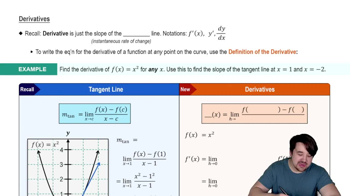
Derivatives

A derivative represents the rate of change of a function with respect to its variable. It is defined as the limit of the average rate of change of the function as the interval approaches zero. In practical terms, the derivative at a point gives the slope of the tangent line to the function at that point.
Recommended video:
05:44
Derivatives

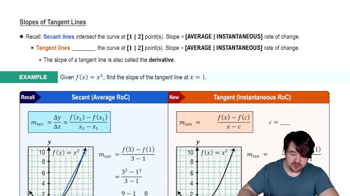
Tangent Lines

A tangent line to a curve at a given point is a straight line that touches the curve at that point without crossing it. The slope of the tangent line is equal to the derivative of the function at that point. This concept is crucial for understanding how functions behave locally around specific values.
Recommended video:
05:13
Slopes of Tangent Lines

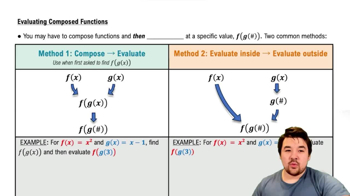
Function Evaluation

Function evaluation involves substituting a specific value into a function to determine its output. In the context of derivatives, evaluating the function at a point helps in calculating the derivative at that point. For example, to find f′(3) for f(x) = x², one must first understand how to compute f(3) and then apply the derivative formula.
Recommended video:
4:26
Evaluating Composed Functions