Ch. 3 - Derivatives
Briggs - Calculus: Early Transcendentals 3rd Edition
Briggs3rd EditionCalculus: Early TranscendentalsISBN: 9780136847243Not the one you use?Change textbook
Chapter 3, Problem 3.2.42

Consider the line f(x)=mx+b, where m and b are constants. Show that f′(x)=m for all x. Interpret this result.

Verified step by step guidance
1
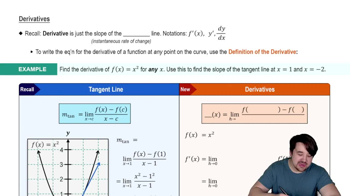
Step 1: Recall the definition of the derivative. The derivative of a function f(x) at a point x is defined as the limit of the average rate of change of the function as the interval approaches zero: f'(x) = \(\lim\)_{h \(\to\) 0} \(\frac{f(x+h) - f(x)}{h}\).
Step 2: Substitute the linear function f(x) = mx + b into the derivative definition. This gives us f'(x) = \(\lim\)_{h \(\to\) 0} \(\frac{(m(x+h) + b) - (mx + b)}{h}\).
Step 3: Simplify the expression inside the limit. The terms b and -b cancel out, and we are left with f'(x) = \(\lim\)_{h \(\to\) 0} \(\frac{mx + mh - mx}{h}\).
Step 4: Further simplify the expression. The terms mx and -mx cancel out, leaving f'(x) = \(\lim\)_{h \(\to\) 0} \(\frac{mh}{h}\).
Step 5: Simplify the fraction \(\frac{mh}{h}\) to m, since h/h = 1 for h ≠ 0. Therefore, f'(x) = m for all x. This result shows that the slope of the line, m, is constant, and the derivative of a linear function is the slope of the line.

Verified video answer for a similar problem:

This video solution was recommended by our tutors as helpful for the problem above.
Video duration:
2m
Was this helpful?

Key Concepts

Here are the essential concepts you must grasp in order to answer the question correctly.

Derivative

The derivative of a function measures the rate at which the function's value changes as its input changes. It is defined as the limit of the average rate of change of the function over an interval as the interval approaches zero. For a linear function like f(x) = mx + b, the derivative represents the slope of the line, which is constant.
Recommended video:
05:44
Derivatives

Linear Functions

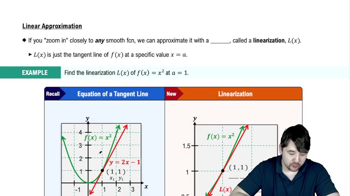
A linear function is a polynomial function of degree one, represented in the form f(x) = mx + b, where m is the slope and b is the y-intercept. The graph of a linear function is a straight line, and its slope (m) indicates how steep the line is. Since the slope is constant, the derivative of a linear function is the same for all values of x.
Recommended video:
07:17
Linearization

Interpretation of the Derivative

The derivative can be interpreted as the instantaneous rate of change of a function at a given point. In the context of the linear function f(x) = mx + b, the result f′(x) = m indicates that the rate of change is constant across all x-values. This means that for every unit increase in x, the function f(x) increases by m units, reflecting the uniform behavior of linear functions.
Recommended video:
05:44
Derivatives