
Ch. 3 - Derivatives
Briggs - Calculus: Early Transcendentals 3rd Edition
Briggs3rd EditionCalculus: Early TranscendentalsISBN: 9780136847243Not the one you use?Change textbook
Chapter 3, Problem 96c

Composition containing sin x Suppose f is differentiable on [−2,2] with f′(0)=3 and f′(1)=5. Let g(x)=f(sin x). Evaluate the following expressions.
c. g'(π)

Verified step by step guidance
1
Step 1: Recognize that g(x) is a composition of functions, where g(x) = f(sin x). To find g'(x), we need to use the chain rule for differentiation.
Step 2: The chain rule states that if you have a composition of functions h(x) = f(u(x)), then the derivative h'(x) = f'(u(x)) * u'(x).
Step 3: In this problem, u(x) = sin x, so u'(x) = cos x. Therefore, g'(x) = f'(sin x) * cos x.
Step 4: We need to evaluate g'(π). First, find sin(π), which is 0. So, g'(π) = f'(sin(π)) * cos(π).
Step 5: Substitute the known values: f'(0) = 3 and cos(π) = -1. Therefore, g'(π) = f'(0) * (-1).

Verified video answer for a similar problem:

This video solution was recommended by our tutors as helpful for the problem above.
Video duration:
3m
Was this helpful?

Key Concepts

Here are the essential concepts you must grasp in order to answer the question correctly.

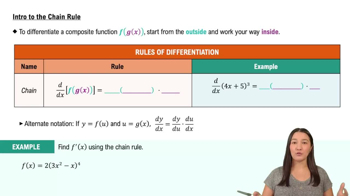
Chain Rule

The Chain Rule is a fundamental principle in calculus used to differentiate composite functions. It states that if you have a function g(x) = f(h(x)), the derivative g'(x) can be found by multiplying the derivative of the outer function f with the derivative of the inner function h. This rule is essential for evaluating derivatives of functions that are composed of other functions.
Recommended video:
05:02
Intro to the Chain Rule

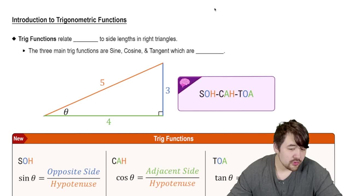
Trigonometric Functions

Trigonometric functions, such as sine and cosine, are periodic functions that relate angles to ratios of sides in right triangles. In this context, sin(x) is used as the inner function in the composition g(x) = f(sin x). Understanding the behavior and derivatives of these functions is crucial for evaluating expressions involving them, especially at specific points like π.
Recommended video:
6:04
Introduction to Trigonometric Functions

Differentiability

A function is said to be differentiable at a point if it has a defined derivative there, which implies that the function is smooth and continuous at that point. In this problem, knowing that f is differentiable on the interval [−2,2] allows us to apply the Chain Rule confidently, as we can use the given derivatives f′(0) and f′(1) to find g'(π) through the composition of functions.
Recommended video:
05:53
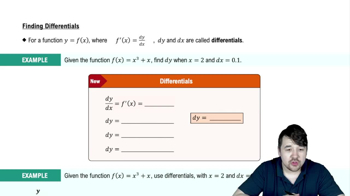
Finding Differentials