Ch. 3 - Derivatives
Briggs - Calculus: Early Transcendentals 3rd Edition
Briggs3rd EditionCalculus: Early TranscendentalsISBN: 9780136847243Not the one you use?Change textbook
Chapter 3, Problem 3.11.8

At all times, the length of the long leg of a right triangle is 3 times the length x of the short leg of the triangle. If the area of the triangle changes with respect to time t, find equations relating the area A to x and dA/dt to dx/dt.

Verified step by step guidance
1
Start by expressing the relationship between the lengths of the legs of the triangle. Let the short leg be x, then the long leg is 3x.
The area A of a right triangle is given by the formula: A = (1/2) * base * height. Here, the base is x and the height is 3x, so A = (1/2) * x * 3x.
Simplify the expression for the area: A = (3/2) * x^2.
To find the relationship between dA/dt and dx/dt, use the chain rule for differentiation. Differentiate A with respect to t: dA/dt = d/dt[(3/2) * x^2].
Apply the chain rule: dA/dt = (3/2) * 2x * (dx/dt), which simplifies to dA/dt = 3x * (dx/dt). This equation relates the rate of change of the area to the rate of change of the short leg.

Verified video answer for a similar problem:

This video solution was recommended by our tutors as helpful for the problem above.
Video duration:
2m
Was this helpful?

Key Concepts

Here are the essential concepts you must grasp in order to answer the question correctly.

Area of a Right Triangle

The area A of a right triangle can be calculated using the formula A = (1/2) * base * height. In this case, the base can be considered the short leg (x) and the height the long leg, which is 3x. Therefore, the area can be expressed as A = (1/2) * x * (3x) = (3/2)x^2.
Recommended video:
05:59
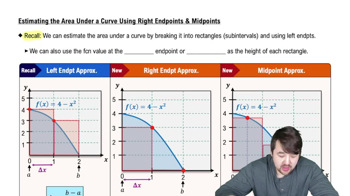
Estimating the Area Under a Curve with Right Endpoints & Midpoint

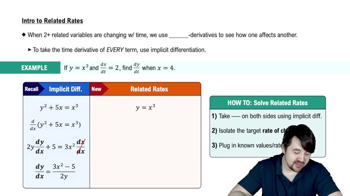
Related Rates

Related rates involve finding the relationship between the rates at which two or more quantities change. In this problem, we need to relate the rate of change of the area (dA/dt) to the rate of change of the short leg (dx/dt). This is typically done using implicit differentiation with respect to time.
Recommended video:
04:16
Intro To Related Rates

Chain Rule

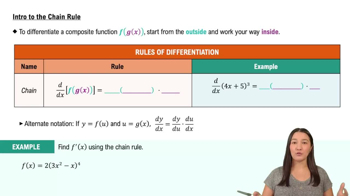
The chain rule is a fundamental principle in calculus used to differentiate composite functions. When applying the chain rule in this context, we differentiate the area A with respect to time t, leading to dA/dt = (dA/dx)(dx/dt). This allows us to express how the area changes as the length of the short leg changes.
Recommended video:
05:02
Intro to the Chain Rule