Ch. 3 - Derivatives
Briggs - Calculus: Early Transcendentals 3rd Edition
Briggs3rd EditionCalculus: Early TranscendentalsISBN: 9780136847243Not the one you use?Change textbook
Chapter 3, Problem 3.11.31

A water heater that has the shape of a right cylindrical tank with a radius of 1 ft and a height of 4 ft is being drained. How fast is water draining out of the tank (in ft³/min) if the water level is dropping at 6 min/in?

Verified step by step guidance
1
First, identify the shape of the tank. It is a right cylindrical tank, which means its volume can be calculated using the formula for the volume of a cylinder: \( V = \pi r^2 h \), where \( r \) is the radius and \( h \) is the height.
Given that the radius \( r \) is 1 ft and the height \( h \) is 4 ft, the volume of the tank is \( V = \pi (1)^2 h = \pi h \).
The problem states that the water level is dropping at a rate of 6 min/in. To find the rate at which the volume is changing, we need to relate the change in height to the change in volume. Use the chain rule to differentiate the volume with respect to time: \( \frac{dV}{dt} = \pi \frac{dh}{dt} \).
Convert the rate of change of the water level from min/in to ft/min. Since 1 inch is \( \frac{1}{12} \) ft, the rate \( \frac{dh}{dt} \) is \( 6 \text{ min/in} \times \frac{1}{12} \text{ ft/in} = \frac{1}{2} \text{ ft/min} \).
Substitute \( \frac{dh}{dt} = \frac{1}{2} \text{ ft/min} \) into the differentiated volume formula: \( \frac{dV}{dt} = \pi \times \frac{1}{2} \). This gives the rate at which the water is draining out of the tank in ft³/min.

Verified video answer for a similar problem:

This video solution was recommended by our tutors as helpful for the problem above.
Video duration:
4m
Was this helpful?

Key Concepts

Here are the essential concepts you must grasp in order to answer the question correctly.

Volume of a Cylinder

The volume of a right circular cylinder is calculated using the formula V = πr²h, where r is the radius and h is the height. In this problem, the tank's radius is given as 1 ft, and the height is 4 ft. Understanding this formula is essential for determining how the volume of water changes as the water level drops.
Recommended video:
08:29
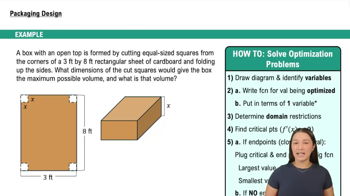
Example 5: Packaging Design

Related Rates

Related rates involve finding the rate at which one quantity changes in relation to another. In this scenario, we need to relate the rate of change of the water level (height) to the rate of change of the volume of water in the tank. This concept is crucial for applying calculus to solve problems involving dynamic systems.
Recommended video:
04:16
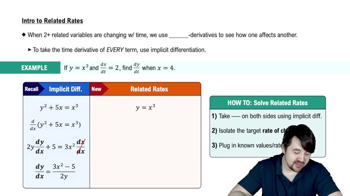
Intro To Related Rates

Differentiation

Differentiation is a fundamental concept in calculus that deals with finding the rate of change of a function. In this context, we will differentiate the volume of the cylinder with respect to time to find the rate at which water is draining from the tank. This process allows us to connect the change in height to the change in volume.
Recommended video:
05:53
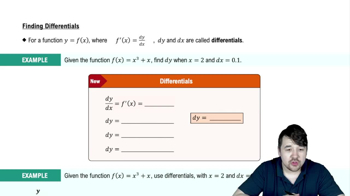
Finding Differentials