Ch. 3 - Derivatives
Briggs - Calculus: Early Transcendentals 3rd Edition
Briggs3rd EditionCalculus: Early TranscendentalsISBN: 9780136847243Not the one you use?Change textbook
Chapter 3, Problem 3.8.88

A challenging derivative Find dy/dx, where √3x⁷+y² = sin²y+100xy.

Verified step by step guidance
1
Start by differentiating both sides of the equation with respect to x. Remember that y is a function of x, so you'll need to use implicit differentiation.
Differentiate the left side: The derivative of \( \sqrt{3x^7} \) with respect to x is \( \frac{d}{dx}(\sqrt{3x^7}) \). Use the chain rule to find this derivative.
For the term \( y^2 \), apply the chain rule: \( \frac{d}{dx}(y^2) = 2y \frac{dy}{dx} \).
Differentiate the right side: For \( \sin^2(y) \), use the chain rule: \( \frac{d}{dx}(\sin^2(y)) = 2\sin(y)\cos(y) \frac{dy}{dx} \). For the term \( 100xy \), apply the product rule: \( \frac{d}{dx}(100xy) = 100(x \frac{dy}{dx} + y) \).
After differentiating, collect all terms involving \( \frac{dy}{dx} \) on one side of the equation and factor out \( \frac{dy}{dx} \). Solve for \( \frac{dy}{dx} \) to find the derivative.

Verified video answer for a similar problem:

This video solution was recommended by our tutors as helpful for the problem above.
Video duration:
13m
Was this helpful?

Key Concepts

Here are the essential concepts you must grasp in order to answer the question correctly.

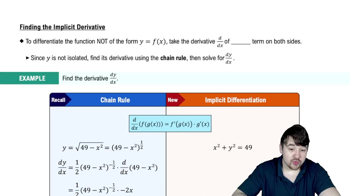
Implicit Differentiation

Implicit differentiation is a technique used to find the derivative of a function that is not explicitly solved for one variable in terms of another. In cases where y is defined implicitly by an equation involving both x and y, we differentiate both sides of the equation with respect to x, applying the chain rule to terms involving y. This allows us to find dy/dx without isolating y.
Recommended video:
05:14
Finding The Implicit Derivative

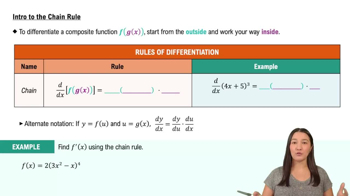
Chain Rule

The chain rule is a fundamental principle in calculus that allows us to differentiate composite functions. It states that if a function y is defined as a function of u, which in turn is a function of x, then the derivative of y with respect to x can be found by multiplying the derivative of y with respect to u by the derivative of u with respect to x. This is crucial when differentiating terms involving y in implicit differentiation.
Recommended video:
05:02
Intro to the Chain Rule

Trigonometric Identities

Trigonometric identities are equations involving trigonometric functions that hold true for all values of the variables involved. In this context, recognizing that sin²y can be differentiated using the identity sin²y + cos²y = 1 is important. This understanding helps simplify the differentiation process and manage the terms effectively when applying implicit differentiation.
Recommended video:
7:17
Verifying Trig Equations as Identities