
Ch. 3 - Derivatives
Briggs - Calculus: Early Transcendentals 3rd Edition
Briggs3rd EditionCalculus: Early TranscendentalsISBN: 9780136847243Not the one you use?Change textbook
Chapter 3, Problem 3.8.58b

58–59. Carry out the following steps.
b. Find the slope of the curve at the given point.
xy^5/2+x^3/2y=12; (4, 1)

Verified step by step guidance
1
First, understand that the problem requires finding the slope of the curve at a specific point, which involves calculating the derivative of the given equation implicitly.
The given equation is \( xy^{\frac{5}{2}} + x^{\frac{3}{2}}y = 12 \). To find the derivative, we will use implicit differentiation since the equation involves both x and y.
Differentiate both sides of the equation with respect to x. Remember to apply the product rule where necessary. For example, when differentiating \( xy^{\frac{5}{2}} \), treat it as a product of x and \( y^{\frac{5}{2}} \).
After differentiating, you will have an expression involving \( \frac{dy}{dx} \). Solve this expression for \( \frac{dy}{dx} \) to find the derivative, which represents the slope of the curve.
Finally, substitute the given point (4, 1) into the derivative expression to find the slope at that specific point.

Verified video answer for a similar problem:

This video solution was recommended by our tutors as helpful for the problem above.
Video duration:
10m
Was this helpful?

Key Concepts

Here are the essential concepts you must grasp in order to answer the question correctly.

Implicit Differentiation

Implicit differentiation is a technique used to differentiate equations where the dependent and independent variables are not explicitly separated. In this case, we differentiate both sides of the equation with respect to x, treating y as a function of x. This allows us to find dy/dx, which represents the slope of the curve at any point.
Recommended video:
05:14
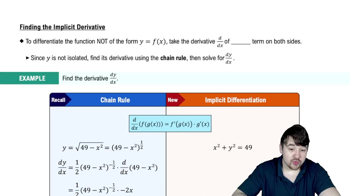
Finding The Implicit Derivative

Slope of a Curve

The slope of a curve at a given point is defined as the rate of change of the y-coordinate with respect to the x-coordinate at that point. Mathematically, it is represented by the derivative of the function at that point. For implicit functions, the slope can be found by evaluating dy/dx after applying implicit differentiation.
Recommended video:
11:41
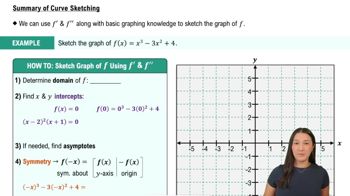
Summary of Curve Sketching

Evaluating Derivatives at a Point

Once the derivative (dy/dx) is found using implicit differentiation, the next step is to evaluate it at a specific point, in this case, (4, 1). This involves substituting the x and y values into the derivative expression to calculate the exact slope of the curve at that point, providing insight into the curve's behavior.
Recommended video:
04:50
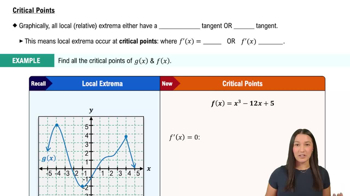
Critical Points
Related Practice
Textbook Question

Owlet talons Let L (t) equal the average length (in mm) of the middle talon on an Indian spotted owlet that is t weeks old, as shown in the figure.<IMAGE>

b. Estimate the value of L'(a) for a ≥ 4 . What does this tell you about the talon lengths on these birds? (Source: ZooKeys, 132, 2011)

1
views
Textbook Question

Vertical tangent lines

b. Does the curve have any horizontal tangent lines? Explain.

Textbook Question

{Use of Tech} A mixing tank A 500-liter (L) tank is filled with pure water. At time t=0, a salt solution begins flowing into the tank at a rate of 5 L/min. At the same time, the (fully mixed) solution flows out of the tank at a rate of 5.5 L/min. The mass of salt in grams in the tank at any time t≥0 is given by M(t) = 250(1000−t)(1−10−³⁰(1000−t)¹⁰) and the volume of solution in the tank is given by V(t) = 500-0.5t.

b. Graph the volume function and verify that the tank is empty when t=1000 min. 

Textbook Question

Deriving trigonometric identities

b. Verify that you obtain the same identity for sin2t as in part (a) if you differentiate the identity cos 2t = 2 cos² t−1.

1
views
Textbook Question

13-26 Implicit differentiation Carry out the following steps.

b. Find the slope of the curve at the given point.

sin y = 5x⁴−5; (1, π)

1
views
Textbook Question

City urbanization City planners model the size of their city using the function A(t) = - 1/50t² + 2t +20, for 0 ≤ t ≤ 50, where A is measured in square miles and t is the number of years after 2010.

b. How fast will the city be growing when it reaches a size of 38 mi²?

1
views