
Textbook Question
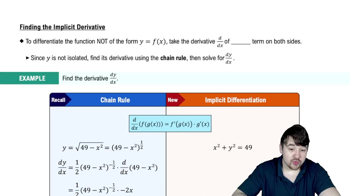
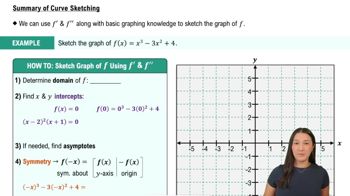
79–82. {Use of Tech} Visualizing tangent and normal lines
b. Graph the tangent and normal lines on the given graph.
x⁴ = 2x²+2y²; (x0, y0)=(2, 2) (kampyle of Eudoxus)

 Verified step by step guidance
 05:14
05:14
 11:41
11:41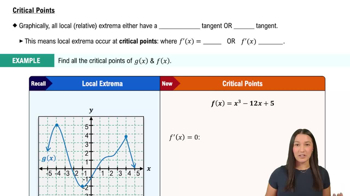 04:50
04:5079–82. {Use of Tech} Visualizing tangent and normal lines
b. Graph the tangent and normal lines on the given graph.
x⁴ = 2x²+2y²; (x0, y0)=(2, 2) (kampyle of Eudoxus)
Surface area of a cone The lateral surface area of a cone of radius r and height h (the surface area excluding the base) is A = πr√r²+h².
b. Evaluate this derivative when r=30 and h=40.
Suppose f(3) = 1 and f′(3) = 4. Let g(x) = x2 + f(x) and h(x) = 3f(x).
Find an equation of the line tangent to y = h(x) at x = 3.
13-26 Implicit differentiation Carry out the following steps.
b. Find the slope of the curve at the given point.
x = e^y; (2, ln 2)
{Use of Tech} Spring oscillations A spring hangs from the ceiling at equilibrium with a mass attached to its end. Suppose you pull downward on the mass and release it 10 inches below its equilibrium position with an upward push. The distance x (in inches) of the mass from its equilibrium position after t seconds is given by the function x(t) = 10sin t - 10cos t, where x is positive when the mass is above the equilibrium position. <IMAGE>
b. Find dx/dt and interpret the meaning of this derivative.
21–30. Derivatives
b. Evaluate f'(a) for the given values of a.
f(x) = 1/x+1; a = -1/2;5