Ch. 3 - Derivatives
Briggs - Calculus: Early Transcendentals 3rd Edition
Briggs3rd EditionCalculus: Early TranscendentalsISBN: 9780136847243Not the one you use?Change textbook
Chapter 3, Problem 3.7.109b

109-112 {Use of Tech} Calculating limits The following limits are the derivatives of a composite function g at a point a.
b. Use the Chain Rule to find each limit. Verify your answer by using a calculator.
limx2(x23)51x2{\(\displaystyle\]\lim\)_{x\(\to\)2}}\(\frac{\left(x^2-3\right)^5-1}{x-2}\)

Verified step by step guidance
1
Step 1: Recognize that the given limit is in the form of a derivative. Specifically, it resembles the definition of the derivative of a function at a point, which is \( \lim_{x \to a} \frac{f(x) - f(a)}{x - a} \).
Step 2: Identify the inner function \( u(x) = x^2 - 3 \) and the outer function \( h(u) = u^5 \). The composite function is \( g(x) = h(u(x)) = (x^2 - 3)^5 \).
Step 3: Apply the Chain Rule to find the derivative of \( g(x) \) at \( x = 2 \). The Chain Rule states that \( g'(x) = h'(u(x)) \cdot u'(x) \).
Step 4: Calculate \( u'(x) \), the derivative of the inner function: \( u'(x) = \frac{d}{dx}(x^2 - 3) = 2x \).
Step 5: Calculate \( h'(u) \), the derivative of the outer function: \( h'(u) = \frac{d}{du}(u^5) = 5u^4 \). Evaluate \( h'(u) \) at \( u = u(2) = 1 \), and use these derivatives to find \( g'(2) \).

Verified video answer for a similar problem:

This video solution was recommended by our tutors as helpful for the problem above.
Video duration:
5m
Was this helpful?

Key Concepts

Here are the essential concepts you must grasp in order to answer the question correctly.

Limits

Limits are fundamental in calculus, representing the value that a function approaches as the input approaches a certain point. In this context, the limit is evaluated as x approaches 2, which is crucial for determining the behavior of the function near that point. Understanding limits helps in analyzing continuity and the behavior of functions, especially when direct substitution leads to indeterminate forms.
Recommended video:
05:50
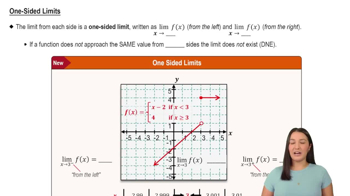
One-Sided Limits

Chain Rule

The Chain Rule is a differentiation technique used to find the derivative of composite functions. It states that if a function y is composed of two functions u and v, then the derivative of y with respect to x can be found by multiplying the derivative of y with respect to u by the derivative of u with respect to x. This rule is essential for solving the limit in the question, as it allows for the differentiation of the outer function while considering the inner function's behavior.
Recommended video:
05:02
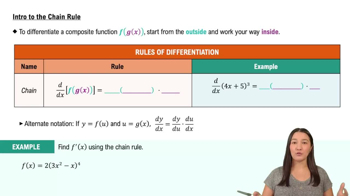
Intro to the Chain Rule

Indeterminate Forms

Indeterminate forms occur in calculus when evaluating limits leads to expressions like 0/0 or ∞/∞, which do not provide clear information about the limit's value. In this problem, substituting x = 2 directly into the limit results in the form 0/0, necessitating the use of algebraic manipulation or L'Hôpital's Rule to resolve the limit. Recognizing and handling indeterminate forms is crucial for accurately finding limits in calculus.
Recommended video:
Guided course
3:56
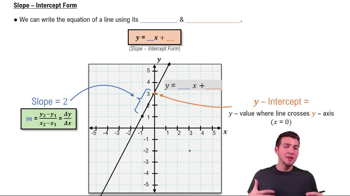
Slope-Intercept Form