Ch. 2 - Limits
Briggs - Calculus: Early Transcendentals 3rd Edition
Briggs3rd EditionCalculus: Early TranscendentalsISBN: 9780136847243Not the one you use?Change textbook
Chapter 2, Problem 2.6.15

What is the domain of f(x)=e^x/x and where is f continuous?

Verified step by step guidance
1
Step 1: Identify the domain of the function.
Step 2: Recognize that the function f(x) = \(\frac{e^x}{x}\) is a rational function.
Step 3: Determine where the denominator is zero, since division by zero is undefined.
Step 4: Set the denominator x equal to zero and solve for x.
Step 5: Conclude that the domain of f(x) is all real numbers except x = 0, and f is continuous on its domain.

Verified video answer for a similar problem:

This video solution was recommended by our tutors as helpful for the problem above.
Video duration:
1m
Was this helpful?

Key Concepts

Here are the essential concepts you must grasp in order to answer the question correctly.

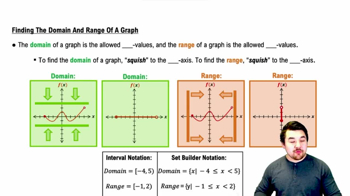
Domain of a Function

The domain of a function refers to the set of all possible input values (x-values) for which the function is defined. For the function f(x) = e^x/x, we need to identify values of x that do not lead to undefined expressions, such as division by zero. In this case, the function is undefined at x = 0, so the domain is all real numbers except zero.
Recommended video:
5:10
Finding the Domain and Range of a Graph

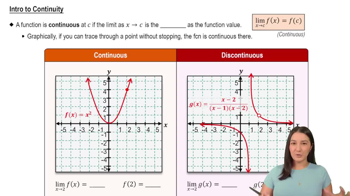
Continuity of a Function

A function is continuous at a point if the limit of the function as it approaches that point equals the function's value at that point. For f(x) = e^x/x, we must check continuity at all points in its domain. Since the function is undefined at x = 0, it is not continuous there, but it is continuous for all other real numbers.
Recommended video:
05:34
Intro to Continuity

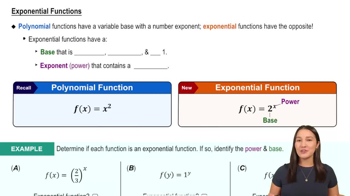
Exponential Functions

Exponential functions, such as e^x, are characterized by a constant base raised to a variable exponent. They are defined for all real numbers and exhibit rapid growth. In the context of f(x) = e^x/x, the exponential component contributes to the function's behavior as x approaches positive or negative infinity, influencing its overall continuity and limits.
Recommended video:
6:13
Exponential Functions