Ch. 2 - Limits
Briggs - Calculus: Early Transcendentals 3rd Edition
Briggs3rd EditionCalculus: Early TranscendentalsISBN: 9780136847243Not the one you use?Change textbook
Chapter 2, Problem 2.7.42

Use the precise definition of a limit to prove the following limits. Specify a relationship between ε and δ that guarantees the limit exists.
lim x→5 1/x^2=1/25

Verified step by step guidance
1
Start by recalling the precise definition of a limit: For every \( \varepsilon > 0 \), there exists a \( \delta > 0 \) such that if \( 0 < |x - 5| < \delta \), then \( \left| \frac{1}{x^2} - \frac{1}{25} \right| < \varepsilon \).
Simplify the expression \( \left| \frac{1}{x^2} - \frac{1}{25} \right| \) to find a relationship between \( \varepsilon \) and \( \delta \). This can be rewritten as \( \left| \frac{25 - x^2}{25x^2} \right| \).
Factor the numerator \( 25 - x^2 \) as \( (5 - x)(5 + x) \), so the expression becomes \( \left| \frac{(5 - x)(5 + x)}{25x^2} \right| \).
To ensure \( \left| \frac{(5 - x)(5 + x)}{25x^2} \right| < \varepsilon \), we need to bound \( |5 + x| \) and \( |x^2| \) by choosing \( \delta \) such that \( |x - 5| < \delta \) implies \( |x - 5| < 1 \), which gives \( 4 < x < 6 \).
Within this interval, \( |5 + x| \) is bounded by 11, and \( x^2 \) is bounded below by 16, so choose \( \delta \) such that \( \delta = \min\left(1, \frac{16\varepsilon}{11}\right) \) to satisfy the condition \( \left| \frac{(5 - x)(5 + x)}{25x^2} \right| < \varepsilon \).

Verified video answer for a similar problem:

This video solution was recommended by our tutors as helpful for the problem above.
Video duration:
8m
Was this helpful?

Key Concepts

Here are the essential concepts you must grasp in order to answer the question correctly.

Limit Definition

The precise definition of a limit states that for a function f(x) to approach a limit L as x approaches a value a, for every ε > 0, there exists a δ > 0 such that if 0 < |x - a| < δ, then |f(x) - L| < ε. This formalism is essential for rigorously proving limits in calculus.
Recommended video:
05:50
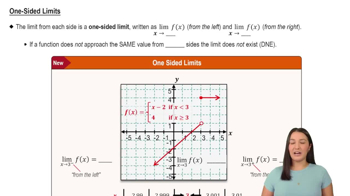
One-Sided Limits

Epsilon-Delta Relationship

In the context of limits, the ε (epsilon) represents how close f(x) must be to the limit L, while δ (delta) represents how close x must be to the point a. Establishing a relationship between ε and δ is crucial for demonstrating that as x gets sufficiently close to a, f(x) will be within ε of L, thus proving the limit exists.
Recommended video:
05:53
Finding Differentials

Continuous Functions

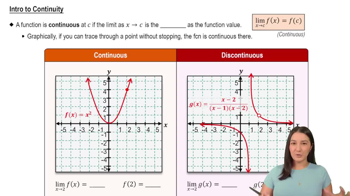
A function is continuous at a point if the limit as x approaches that point equals the function's value at that point. In this case, since 1/x^2 is continuous around x = 5, we can directly apply the limit definition without concerns about discontinuities, simplifying the proof process.
Recommended video:
05:34
Intro to Continuity