Ch. 2 - Limits
Briggs - Calculus: Early Transcendentals 3rd Edition
Briggs3rd EditionCalculus: Early TranscendentalsISBN: 9780136847243Not the one you use?Change textbook
Chapter 2, Problem 4h

Use the graph of f in the figure to evaluate the function or analyze the limit. <IMAGE>
lim x→3^− f(x)

Verified step by step guidance
1
Identify the point of interest, which is x = 3, and note that the limit is from the left (x → 3^−).
Examine the graph of the function f(x) as x approaches 3 from values less than 3.
Observe the behavior of f(x) as x gets closer to 3 from the left side. Look for the y-value that f(x) approaches.
Determine if the function approaches a specific value, or if it diverges or has a discontinuity at x = 3.
Conclude the limit by stating the y-value that f(x) approaches as x approaches 3 from the left.

Verified video answer for a similar problem:

This video solution was recommended by our tutors as helpful for the problem above.
Video duration:
2m
Was this helpful?

Key Concepts

Here are the essential concepts you must grasp in order to answer the question correctly.

Limits

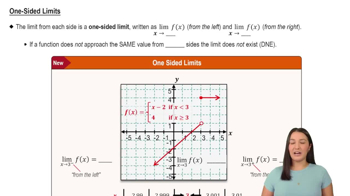
A limit is a fundamental concept in calculus that describes the behavior of a function as its input approaches a certain value. Specifically, the notation lim x→a f(x) indicates the value that f(x) approaches as x gets arbitrarily close to a from either the left (denoted as 3^−) or the right. Understanding limits is crucial for analyzing continuity, derivatives, and integrals.
Recommended video:
05:50
One-Sided Limits

One-Sided Limits

One-sided limits refer to the evaluation of a limit from one direction only. The notation lim x→a^− f(x) signifies the limit of f(x) as x approaches a from the left side. This concept is particularly important when dealing with functions that may have different behaviors or discontinuities at a specific point.
Recommended video:
05:50
One-Sided Limits

Graphical Analysis

Graphical analysis involves interpreting the visual representation of a function to understand its behavior, including limits, continuity, and asymptotic behavior. By examining the graph of f near the point of interest (x=3), one can determine the value that f(x) approaches as x approaches 3 from the left, which is essential for evaluating the limit.
Recommended video:
06:29
Derivatives Applied To Velocity