Ch. 2 - Limits
Briggs - Calculus: Early Transcendentals 3rd Edition
Briggs3rd EditionCalculus: Early TranscendentalsISBN: 9780136847243Not the one you use?Change textbook
Chapter 2, Problem 4b

Use the graph of f in the figure to evaluate the function or analyze the limit. <IMAGE>
lim x→−1^− f(x)

Verified step by step guidance
1
Identify the type of limit: The problem asks for the left-hand limit of the function \( f(x) \) as \( x \) approaches \(-1\). This is denoted as \( \lim_{{x \to -1^-}} f(x) \).
Understand the notation: The notation \( x \to -1^- \) means that \( x \) is approaching \(-1\) from the left side, or from values less than \(-1\).
Examine the graph: Look at the behavior of the function \( f(x) \) as \( x \) gets closer to \(-1\) from the left. Observe the y-values that \( f(x) \) approaches.
Determine the limit: Based on the graph, identify the value that \( f(x) \) approaches as \( x \) approaches \(-1\) from the left.
Conclude the analysis: State the left-hand limit of \( f(x) \) as \( x \) approaches \(-1\) based on your observations from the graph.

Verified video answer for a similar problem:

This video solution was recommended by our tutors as helpful for the problem above.
Video duration:
3m
Was this helpful?

Key Concepts

Here are the essential concepts you must grasp in order to answer the question correctly.

Limits

A limit is a fundamental concept in calculus that describes the behavior of a function as its input approaches a certain value. In this case, we are interested in the left-hand limit as x approaches -1, denoted as lim x→−1^− f(x). This means we examine the values of f(x) as x gets closer to -1 from the left side, which helps us understand the function's behavior at that point.
Recommended video:
05:50
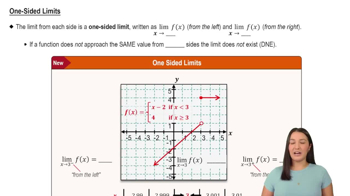
One-Sided Limits

Left-Hand Limit

The left-hand limit refers specifically to the value that a function approaches as the input approaches a certain point from the left. It is denoted as lim x→c^− f(x) for a function f(x) as x approaches c. This concept is crucial for evaluating limits at points where the function may not be defined or may behave differently from the right-hand side.
Recommended video:
05:50
One-Sided Limits

Graphical Analysis

Graphical analysis involves using the visual representation of a function to understand its behavior, including limits, continuity, and discontinuities. By examining the graph of f, one can identify the value that f(x) approaches as x approaches -1 from the left, which is essential for accurately evaluating the limit in the given question.
Recommended video:
06:29
Derivatives Applied To Velocity