Ch. 2 - Limits
Briggs - Calculus: Early Transcendentals 3rd Edition
Briggs3rd EditionCalculus: Early TranscendentalsISBN: 9780136847243Not the one you use?Change textbook
Chapter 2, Problem 2.4.65

Use analytical methods and/or a graphing utility to identify the vertical asymptotes (if any) of the following functions.
f(x)=1/ √x sec x

Verified step by step guidance
1
Step 1: Identify the domain of the function. The function f(x) = \( \frac{1}{\sqrt{x} \sec x} \) is defined where both \( \sqrt{x} \) and \( \sec x \) are defined and non-zero. \( \sqrt{x} \) is defined for \( x > 0 \), and \( \sec x = \frac{1}{\cos x} \) is defined where \( \cos x \neq 0 \).
Step 2: Determine where \( \sec x \) is undefined. The secant function, \( \sec x \), is undefined where \( \cos x = 0 \). This occurs at \( x = \frac{\pi}{2} + n\pi \), where \( n \) is an integer.
Step 3: Analyze the behavior of the function near the points where \( \sec x \) is undefined. As \( x \) approaches \( \frac{\pi}{2} + n\pi \), \( \cos x \) approaches 0, causing \( \sec x \) to approach infinity or negative infinity, leading to potential vertical asymptotes.
Step 4: Consider the behavior of \( \sqrt{x} \) as \( x \to 0^+ \). As \( x \to 0^+ \), \( \sqrt{x} \to 0^+ \), which causes the function \( f(x) \) to approach infinity, indicating a potential vertical asymptote at \( x = 0 \).
Step 5: Conclude the locations of the vertical asymptotes. Based on the analysis, the vertical asymptotes occur at \( x = 0 \) and \( x = \frac{\pi}{2} + n\pi \) for integer values of \( n \).

Verified video answer for a similar problem:

This video solution was recommended by our tutors as helpful for the problem above.
Video duration:
2m
Was this helpful?

Key Concepts

Here are the essential concepts you must grasp in order to answer the question correctly.

Vertical Asymptotes

Vertical asymptotes occur in a function when the output approaches infinity as the input approaches a certain value. This typically happens when the function is undefined at that point, often due to division by zero. Identifying vertical asymptotes involves finding values of x that make the denominator zero while ensuring the numerator is not also zero at those points.
Recommended video:
3:40
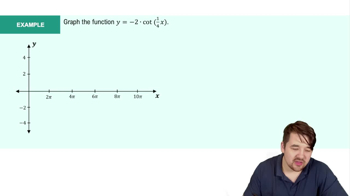
Introduction to Cotangent Graph Example 1

Domain of a Function

The domain of a function is the set of all possible input values (x-values) for which the function is defined. For the function f(x) = 1/√x sec x, the domain is restricted by the square root and the secant function. Understanding the domain is crucial for identifying vertical asymptotes, as any x-value that leads to an undefined function must be considered.
Recommended video:
5:10
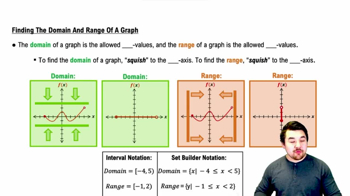
Finding the Domain and Range of a Graph

Graphing Utility

A graphing utility is a tool, often software or a calculator, that allows users to visualize functions and their behaviors. By plotting the function f(x) = 1/√x sec x, one can observe where the function approaches infinity, indicating vertical asymptotes. Graphing utilities can also help in analyzing the overall shape and trends of the function, providing insights that may not be immediately apparent through algebraic methods alone.
Recommended video:
06:15
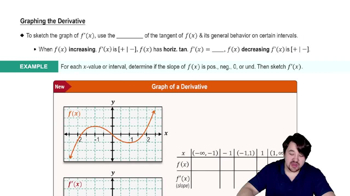
Graphing The Derivative