
Ch. 2 - Limits
Briggs - Calculus: Early Transcendentals 3rd Edition
Briggs3rd EditionCalculus: Early TranscendentalsISBN: 9780136847243Not the one you use?Change textbook
Chapter 2, Problem 2.2.29

Use a graph of f to estimate limxaf(x){\(\displaystyle\]\lim\)_{x\(\to\) a}}f\(\left\)(x\(\right\)) or to show that the limit does not exist. Evaluate f(x) near x=ax=a to support your conjecture.
f(x)=1cos(2x2)(x1)2;a=1f\(\left\)(x\(\right\))=\(\frac{1-\cos\left(2x-2\right)}{\left(x-1\right)^2}\);a=1

Verified step by step guidance
1
Identify the function given: \( f(x) = \frac{1 - \cos(2x - 2)}{(x - 1)^2} \) and the point \( a = 1 \).
Recognize that the limit \( \lim_{x \to 1} f(x) \) involves a \( \frac{0}{0} \) indeterminate form, as both the numerator and denominator approach zero when \( x = 1 \).
Apply L'Hôpital's Rule, which is used to evaluate limits of indeterminate forms \( \frac{0}{0} \) or \( \frac{\infty}{\infty} \), by differentiating the numerator and the denominator separately.
Differentiate the numerator: \( \frac{d}{dx}[1 - \cos(2x - 2)] = 2\sin(2x - 2) \).
Differentiate the denominator: \( \frac{d}{dx}[(x - 1)^2] = 2(x - 1) \).

Verified video answer for a similar problem:

This video solution was recommended by our tutors as helpful for the problem above.
Video duration:
5m
Was this helpful?

Key Concepts

Here are the essential concepts you must grasp in order to answer the question correctly.

Limit of a Function

The limit of a function describes the behavior of the function as the input approaches a certain value. It is denoted as lim(x→a) f(x) and indicates what value f(x) approaches as x gets closer to a. Understanding limits is crucial for analyzing continuity and differentiability, as well as for evaluating functions that may not be defined at certain points.
Recommended video:
06:11
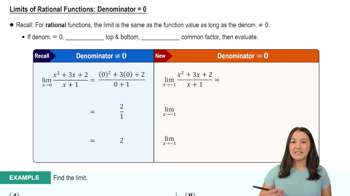
Limits of Rational Functions: Denominator = 0

Continuity

A function is continuous at a point if the limit of the function as it approaches that point equals the function's value at that point. For the function f(x) to be continuous at x = a, it must satisfy three conditions: f(a) must be defined, the limit as x approaches a must exist, and both must be equal. Discontinuities can lead to limits that do not exist or are undefined.
Recommended video:
05:34
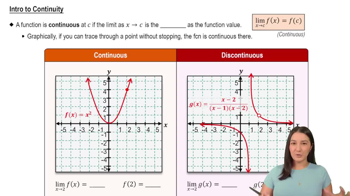
Intro to Continuity

Graphical Interpretation of Limits

Using a graph to estimate limits involves observing the behavior of the function as it approaches a specific x-value. By analyzing the graph, one can identify trends, such as whether the function approaches a finite value, diverges, or oscillates. This visual approach aids in understanding the concept of limits and can provide insights into the existence or non-existence of limits at certain points.
Recommended video:
6:47
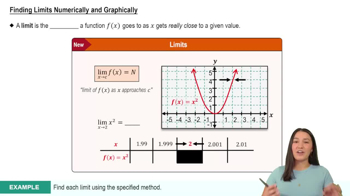
Finding Limits Numerically and Graphically
Related Practice
Textbook Question

A sequence is an infinite, ordered list of numbers that is often defined by a function. For example, the sequence {2,4,6,8,…} is specified by the function f(n) = 2n, where n=1,2,3,….The limit of such a sequence is lim n→∞ f(n), provided the limit exists. All the limit laws for limits at infinity may be applied to limits of sequences. Find the limit of the following sequences or state that the limit does not exist. 


{2,3/4,4/9,5/16,…}, which is defined by f(n) = (n+1) / n^2, for n=1,2,3,…

2
views
Textbook Question

Consider the position function s(t)=−16t^2+128t (Exercise 13). Complete the following table with the appropriate average velocities. Then make a conjecture about the value of the instantaneous velocity at t=1. <IMAGE>

Textbook Question

The following table gives the position s(t)s\(\left\)(t\(\right\)) of an object moving along a line at time tt. Determine the average velocities over the time intervals [1,1.01]\(\left\[\lbrack\)1,1.01\(\right\]\rbrack\), [1,1.001]\(\left\[\lbrack\)1,1.001\(\right\]\rbrack\), and [1,1.0001]\(\left\]\lbrack\)1,1.0001^{}\(\right\).]. Then make a conjecture about the value of the instantaneous velocity at t=1t=1. <IMAGE>

Textbook Question

Evaluate each limit and justify your answer. 

lim x→1 (x+5x / x+2)^4

Textbook Question

Determine the points on the interval (0, 5) at which the following functions f have discontinuities. At each point of discontinuity, state the conditions in the continuity checklist that are violated. <IMAGE>

3
views
Textbook Question

Determine limxf(x)\(\lim\)_{x\(\rightarrow\]\infty\)}f\(\left\)(x\(\right\)) and limxf(x)\(\lim\)_{x\(\rightarrow\)-\(\infty\)}f\(\left\)(x\(\right\)) for the following functions. Then give the horizontal asymptotes of ff (if any).


f(x)=4x3+12x3+16x6+1f\(\left\)(x\(\right\))=\(\frac{4x^3+1}{2x^3+\sqrt{16x^6+1}\)}

3
views