
Textbook Question
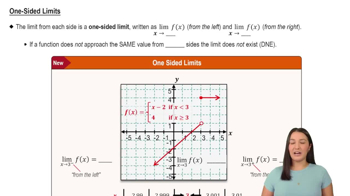
For any real number x, the floor function (or greatest integer function) ⌊x⌋ is the greatest integer less than or equal to x (see figure).
a. Compute lim x→−1^− ⌊x⌋, lim x→−1^+ ⌊x⌋,lim x→2^− ⌊x⌋, and lim x→2^+ ⌊x⌋.

 Verified step by step guidance
 3:40
3:40
 05:50 05:50
For any real number x, the floor function (or greatest integer function) ⌊x⌋ is the greatest integer less than or equal to x (see figure).
a. Compute lim x→−1^− ⌊x⌋, lim x→−1^+ ⌊x⌋,lim x→2^− ⌊x⌋, and lim x→2^+ ⌊x⌋.
Complete the following sentences in terms of a limit.
a. A function is continuous from the left at a if _____.
Determine the following limits.
a.
Determine whether the following statements are true and give an explanation or counterexample.
a. The graph of a function can never cross one of its horizontal asymptotes.
Analyze lim x→∞ f(x) and lim x→−∞ f(x), and then identify any horizontal asymptotes.
f(x) = (x2 − 9)/(x(x−3))
Graph the function f(x)=e^−x / x(x+2)^2 using a graphing utility. (Experiment with your choice of a graphing window.) Use your graph to determine the following limits.
a. lim x→−2^+ f(x)