Ch. 2 - Limits
Briggs - Calculus: Early Transcendentals 3rd Edition
Briggs3rd EditionCalculus: Early TranscendentalsISBN: 9780136847243Not the one you use?Change textbook
Chapter 2, Problem 2.4.7e

The graph of f in the figure has vertical asymptotes at x=1 and x=2. Analyze the following limits. <IMAGE>
lim x→2^+ f(x)

Verified step by step guidance
1
Identify that the limit is asking for the behavior of the function \( f(x) \) as \( x \) approaches 2 from the right (denoted by \( x \to 2^+ \)).
Recognize that a vertical asymptote at \( x = 2 \) implies that as \( x \) approaches 2, \( f(x) \) tends towards infinity or negative infinity.
Since the limit is from the right, consider the values of \( f(x) \) for \( x > 2 \) and observe whether \( f(x) \) increases without bound or decreases without bound.
If the graph shows \( f(x) \) increasing as \( x \to 2^+ \), then \( \lim_{x \to 2^+} f(x) = +\infty \).
If the graph shows \( f(x) \) decreasing as \( x \to 2^+ \), then \( \lim_{x \to 2^+} f(x) = -\infty \).

Verified video answer for a similar problem:

This video solution was recommended by our tutors as helpful for the problem above.
Video duration:
1m
Was this helpful?

Key Concepts

Here are the essential concepts you must grasp in order to answer the question correctly.

Vertical Asymptotes

Vertical asymptotes occur in the graph of a function where the function approaches infinity or negative infinity as the input approaches a certain value. In this case, the function f has vertical asymptotes at x=1 and x=2, indicating that as x approaches these values, f(x) does not settle at a finite value but instead diverges.
Recommended video:
3:40
Introduction to Cotangent Graph Example 1

Limits

A limit describes the behavior of a function as the input approaches a particular point. The notation lim x→2^+ f(x) specifically refers to the limit of f(x) as x approaches 2 from the right side (values greater than 2). Understanding limits is crucial for analyzing the behavior of functions near points of discontinuity, such as vertical asymptotes.
Recommended video:
05:50
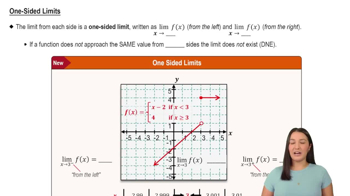
One-Sided Limits

One-Sided Limits

One-sided limits focus on the behavior of a function as the input approaches a specific point from one direction only. The notation lim x→2^+ f(x) indicates a right-hand limit, which is essential for understanding how the function behaves as it nears the vertical asymptote at x=2. This concept helps determine if the function approaches positive or negative infinity in that direction.
Recommended video:
05:50
One-Sided Limits