Ch. 2 - Limits
Briggs - Calculus: Early Transcendentals 3rd Edition
Briggs3rd EditionCalculus: Early TranscendentalsISBN: 9780136847243Not the one you use?Change textbook
Chapter 2, Problem 92a

Suppose you park your car at a trailhead in a national park and begin a 2-hr hike to a lake at 7 A.M. on a Friday morning. On Sunday morning, you leave the lake at 7 A.M. and start the 2-hr hike back to your car. Assume the lake is 3 mi from your car. Let f(t) be your distance from the car t hours after 7 a.m. on Friday morning, and let g(t) be your distance from the car t hours after 7 a.m. on Sunday morning.


a. Evaluate f(0), f(2), g(0), and g(2).

Verified step by step guidance
1
Step 1: Understand the functions f(t) and g(t). The function f(t) represents your distance from the car t hours after 7 a.m. on Friday morning, while g(t) represents your distance from the car t hours after 7 a.m. on Sunday morning.
Step 2: Evaluate f(0). At t = 0 on Friday morning, you are at the trailhead, which is 0 miles from your car. Therefore, f(0) = 0.
Step 3: Evaluate f(2). At t = 2 on Friday morning, you have completed the 2-hour hike to the lake, which is 3 miles from your car. Therefore, f(2) = 3.
Step 4: Evaluate g(0). At t = 0 on Sunday morning, you are at the lake, which is 3 miles from your car. Therefore, g(0) = 3.
Step 5: Evaluate g(2). At t = 2 on Sunday morning, you have completed the 2-hour hike back to your car, which is 0 miles from your car. Therefore, g(2) = 0.

Verified video answer for a similar problem:

This video solution was recommended by our tutors as helpful for the problem above.
Video duration:
3m
Was this helpful?

Key Concepts

Here are the essential concepts you must grasp in order to answer the question correctly.

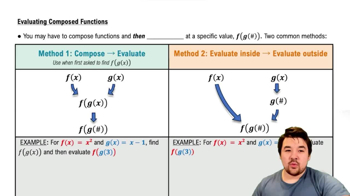
Function Evaluation

Function evaluation involves substituting a specific input value into a function to determine its output. In this context, f(t) and g(t) represent the distance from the car at different times, so evaluating f(0) and f(2) gives the distances at the start and end of the hike to the lake, while g(0) and g(2) provide the distances at the start and end of the return hike.
Recommended video:
4:26
Evaluating Composed Functions

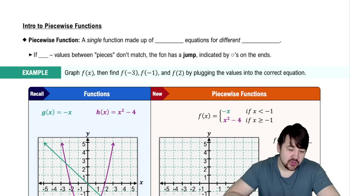
Piecewise Functions

Piecewise functions are defined by different expressions based on the input value. In this scenario, f(t) and g(t) can be considered piecewise because they describe different segments of the journey: f(t) for the hike to the lake and g(t) for the return trip. Understanding how to interpret these functions is crucial for evaluating them correctly.
Recommended video:
05:36
Piecewise Functions

Distance and Time Relationship

The relationship between distance and time is fundamental in calculus, particularly in motion problems. Here, the distance from the car changes over time as the hiker moves towards the lake and back. Recognizing that the total distance is constant (3 miles) and how it is divided over the two hikes helps in understanding the function's behavior and evaluating it accurately.
Recommended video:
5:37
Introduction to Cotangent Graph