Ch. 2 - Limits
Briggs - Calculus: Early Transcendentals 3rd Edition
Briggs3rd EditionCalculus: Early TranscendentalsISBN: 9780136847243Not the one you use?Change textbook
Chapter 2, Problem 2.6.87b

Let g(x)={x2+xif x<1aif x=13x+5if x>1g\(\left\)(x\(\right\))=\(\begin{cases}\)x^2+x & \(\text{if }\)x<1\\ a & \(\text{if }\)x=1\\ 3x+5 & \(\text{if }\)x>1\(\end{cases}\)
b. Determine the value of aa for which gg is continuous from the right at 11

Verified step by step guidance
1
To determine the value of 'a' for which the function g(x) is continuous from the right at x = 1, we need to ensure that the right-hand limit of g(x) as x approaches 1 is equal to g(1).
The right-hand limit of g(x) as x approaches 1 is found by considering the expression for g(x) when x > 1, which is 3x + 5.
Calculate the right-hand limit: \( \lim_{{x \to 1^+}} g(x) = \lim_{{x \to 1^+}} (3x + 5) \).
Evaluate this limit by substituting x = 1 into the expression 3x + 5, which gives 3(1) + 5.
For g(x) to be continuous from the right at x = 1, set the right-hand limit equal to g(1), which is 'a'. Therefore, solve the equation 3(1) + 5 = a to find the value of 'a'.

Verified video answer for a similar problem:

This video solution was recommended by our tutors as helpful for the problem above.
Video duration:
2m
Was this helpful?

Key Concepts

Here are the essential concepts you must grasp in order to answer the question correctly.

Piecewise Functions

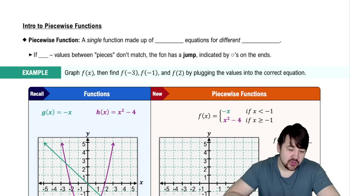
A piecewise function is defined by different expressions based on the input value. In this case, the function g(x) has three distinct cases depending on whether x is less than, equal to, or greater than 1. Understanding how to evaluate piecewise functions is crucial for determining their properties, such as continuity.
Recommended video:
05:36
Piecewise Functions

Continuity

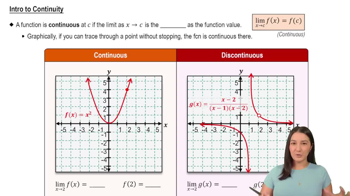
A function is continuous at a point if the limit of the function as it approaches that point from both sides equals the function's value at that point. For g(x) to be continuous at x=1, the limit as x approaches 1 from the left must equal the limit as x approaches 1 from the right, and both must equal g(1). This concept is essential for solving the problem.
Recommended video:
05:34
Intro to Continuity

Limits

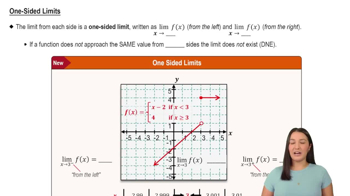
Limits describe the behavior of a function as the input approaches a certain value. In this context, we need to find the left-hand limit (as x approaches 1 from values less than 1) and the right-hand limit (as x approaches 1 from values greater than 1) of g(x). Evaluating these limits will help determine the appropriate value of a that ensures continuity at x=1.
Recommended video:
05:50
One-Sided Limits
Related Practice
Textbook Question

Determine whether the following statements are true and give an explanation or counterexample.

The line x=−1 is a vertical asymptote of the function f(x) =x^2 − 7x + 6 / x^2 − 1.

1
views

Textbook Question

The hyperbolic cosine function, denoted cosh(x)\(\cosh\]\left\)(x\(\right\)), is used to model the shape of a hanging cable (a telephone wire, for example). It is defined as cosh(x)=ex+ex2\(\cosh\]\left\)(x\(\right\))=\(\frac{e^{x}\)+e^{-x}}{2}.


b. Evaluate cosh(0)\(\cosh\]\left\)(0\(\right\)). Use symmetry and part (a) to sketch a plausible graph for y=cosh(x)y=\(\cosh\]\left\)(x\(\right\)).

Textbook Question

Assume you invest \(250 at the end of each year for 10 years at an annual interest rate of rr. The amount of money in your account after 10 years is given by A(r)=250((1+r)101)rA\left(r\right)=\frac{250\left(\left(1+r\right)^{10}-1\right)}{r}. Assume your goal is to have \)3500 in your account after 10 years.


b. Use a calculator to estimate the interest rate required to reach your financial goal.

Textbook Question

The graph of f in the figure has vertical asymptotes at x=1 and x=2. Analyze the following limits. <IMAGE>

lim x→1^+ f(x)

Textbook Question

Complete the following steps for the given functions. 


b. Find the vertical asymptotes of f (if any).


f(x)=3x22x+53x+4f\(\left\)(x\(\right\))=\(\frac{3x^2-2x+5}{3x+4}\)

1
views
Textbook Question

A projectile is fired vertically upward and has a position given by s(t)=−16t^2+128t+192, for 0≤t≤9.


b. From the graph of the position function, identify the time at which the projectile has an instantaneous velocity of zero; call this time t=a.