Ch. 2 - Limits
Briggs - Calculus: Early Transcendentals 3rd Edition
Briggs3rd EditionCalculus: Early TranscendentalsISBN: 9780136847243Not the one you use?Change textbook
Chapter 2, Problem 65

Find the following limits or state that they do not exist. Assume a, b , c, and k are fixed real numbers.
lim t→2+ |2t − 4|t^2 − 4

Verified step by step guidance
1
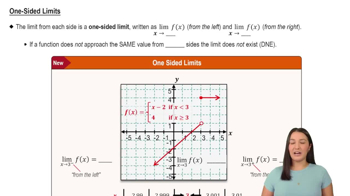
Identify the type of limit: This is a one-sided limit as \( t \to 2^+ \).
Simplify the expression inside the absolute value: \(|2t - 4| = |2(t - 2)| = 2|t - 2|\).
Substitute \( t = 2^+ \) into the expression \( |2t - 4| \). Since \( t \to 2^+ \), \( t - 2 \to 0^+ \), so \(|t - 2| = t - 2\).
Rewrite the limit expression: \( \lim_{t \to 2^+} \frac{2(t - 2)}{t^2 - 4} \).
Factor the denominator: \( t^2 - 4 = (t - 2)(t + 2) \), and simplify the expression to \( \lim_{t \to 2^+} \frac{2}{t + 2} \).

Verified video answer for a similar problem:

This video solution was recommended by our tutors as helpful for the problem above.
Video duration:
4m
Was this helpful?

Key Concepts

Here are the essential concepts you must grasp in order to answer the question correctly.

Limits

A limit is a fundamental concept in calculus that describes the behavior of a function as its input approaches a certain value. It helps in understanding how functions behave near specific points, including points of discontinuity. In this question, we are interested in the limit as t approaches 2 from the right (2+), which requires evaluating the function's behavior just above this point.
Recommended video:
05:50
One-Sided Limits

Absolute Value Function

The absolute value function, denoted as |x|, represents the distance of x from zero on the number line, effectively removing any negative sign. In the context of the limit problem, |2t - 4| will change its expression depending on whether 2t - 4 is positive or negative. Understanding how to handle absolute values is crucial for correctly evaluating the limit as t approaches 2.
Recommended video:
05:03
Initial Value Problems

Indeterminate Forms

Indeterminate forms occur in calculus when evaluating limits leads to expressions like 0/0 or ∞/∞, which do not provide clear information about the limit's value. In this problem, the expression |2t - 4|/(t^2 - 4) may lead to an indeterminate form as t approaches 2, necessitating further analysis, such as factoring or applying L'Hôpital's Rule to resolve the limit.
Recommended video:
Guided course
3:56
Slope-Intercept Form