Ch. 2 - Limits
Briggs - Calculus: Early Transcendentals 3rd Edition
Briggs3rd EditionCalculus: Early TranscendentalsISBN: 9780136847243Not the one you use?Change textbook
Chapter 2, Problem 2.2

Evaluate lim x→∞ f(x) and lim x→−∞ f(x) sing the figure. <IMAGE>

Verified step by step guidance
1
insert step 1
insert step 2
insert step 3
insert step 4
insert step 5

Verified video answer for a similar problem:

This video solution was recommended by our tutors as helpful for the problem above.
Video duration:
2m
Was this helpful?

Key Concepts

Here are the essential concepts you must grasp in order to answer the question correctly.

Limits at Infinity

Limits at infinity refer to the behavior of a function as the input approaches positive or negative infinity. This concept helps determine the end behavior of functions, indicating whether they approach a specific value, diverge, or oscillate. Understanding limits at infinity is crucial for analyzing functions in calculus, especially when evaluating horizontal asymptotes.
Recommended video:
05:50
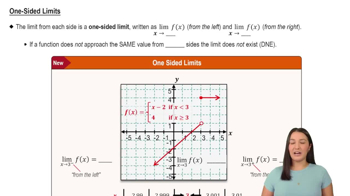
One-Sided Limits

Horizontal Asymptotes

Horizontal asymptotes are lines that a graph approaches as the input values become very large or very small. They indicate the value that a function approaches as x approaches infinity or negative infinity. Identifying horizontal asymptotes is essential for understanding the long-term behavior of rational functions and can be determined using limits.
Recommended video:
5:46
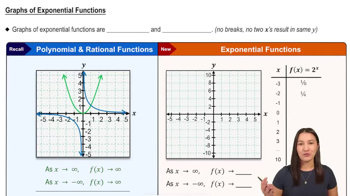
Graphs of Exponential Functions

Graphical Interpretation

Graphical interpretation involves analyzing the visual representation of a function to understand its behavior, including limits and asymptotes. By examining the graph, one can identify trends, such as where the function stabilizes or diverges, which aids in evaluating limits at infinity. This concept emphasizes the importance of visualizing mathematical functions to enhance comprehension.
Recommended video:
05:02
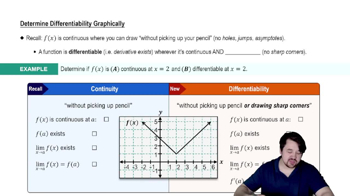
Determining Differentiability Graphically