Ch. 2 - Limits
Briggs - Calculus: Early Transcendentals 3rd Edition
Briggs3rd EditionCalculus: Early TranscendentalsISBN: 9780136847243Not the one you use?Change textbook
Chapter 2, Problem 2.50

Determine the following limits.
limtcos(t)e3t{\(\displaystyle\[\lim\)_{t\(\to\]\infty\)}\(\frac{\cos\left(t\right)}{e^{3t}\)}}

Verified step by step guidance
1
Identify the limit expression: \( \lim_{t \to \infty} \frac{\cos(t)}{e^{3t}} \).
Recognize that \( \cos(t) \) oscillates between -1 and 1 for all \( t \).
Observe that \( e^{3t} \) grows exponentially as \( t \to \infty \).
Consider the behavior of the fraction: as the denominator \( e^{3t} \) becomes very large, the fraction \( \frac{\cos(t)}{e^{3t}} \) approaches zero.
Conclude that the limit is zero because the exponential growth in the denominator dominates the bounded oscillation of the numerator.

Verified video answer for a similar problem:

This video solution was recommended by our tutors as helpful for the problem above.
Video duration:
2m
Was this helpful?

Key Concepts

Here are the essential concepts you must grasp in order to answer the question correctly.

Limits at Infinity

Limits at infinity involve evaluating the behavior of a function as the variable approaches infinity. In this context, we analyze how the function behaves when 't' becomes very large. Understanding this concept is crucial for determining whether the limit converges to a finite value, diverges, or approaches zero.
Recommended video:
05:50
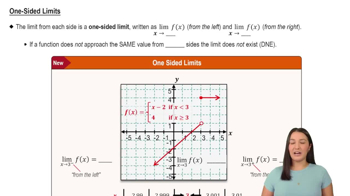
One-Sided Limits

Behavior of Exponential Functions

Exponential functions, such as e^(3t), grow significantly faster than trigonometric functions like cosine(t) as 't' approaches infinity. This rapid growth means that even though cosine oscillates between -1 and 1, the denominator will dominate the fraction, leading to a limit of zero. Recognizing this behavior is essential for solving the limit problem.
Recommended video:
5:46
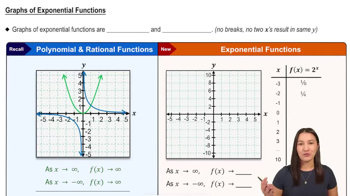
Graphs of Exponential Functions

Trigonometric Functions and Boundedness

Trigonometric functions, such as cosine, are bounded, meaning they have a fixed range of values (between -1 and 1). This property is important when evaluating limits because it indicates that the numerator will not grow indefinitely, allowing us to compare it effectively with the rapidly increasing denominator in the limit expression.
Recommended video:
6:04
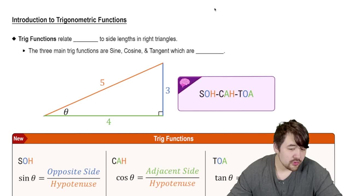
Introduction to Trigonometric Functions
Related Practice
Textbook Question

Determine the following limits.


limz4z5(z210z+24)2{\(\displaystyle\]\lim\)_{z\(\to\)4}}\(\frac{z-5}{\left(z^2-10z+24\right)^2}\)

1
views
Textbook Question

Determine limxf(x)\(\lim\)_{x\(\rightarrow\]\infty\)}f\(\left\)(x\(\right\)) and limxf(x)\(\lim\)_{x\(\rightarrow\)-\(\infty\)}f\(\left\)(x\(\right\)) for the following functions. Then give the horizontal asymptotes of ff (if any).


f(x)=4x(3x9x2+1)f\(\left\)(x\(\right\))=4x\(\left\)(3x-\(\sqrt{9x^2+1}\]\right\))

2
views
Textbook Question

Find the following limits or state that they do not exist. Assume a, b , c, and k are fixed real numbers.


lim p→2 3p / √4p + 1 − 1

Textbook Question

Determine limxf(x)\(\lim\)_{x\(\rightarrow\]\infty\)}f\(\left\)(x\(\right\)) and limxf(x)\(\lim\)_{x\(\rightarrow\)-\(\infty\)}f\(\left\)(x\(\right\)) for the following functions. Then give the horizontal asymptotes of ff (if any).


f(x)=6x29x+83x2+2f\(\left\)(x\(\right\))=\(\frac{6x^2-9x+8}{3x^2+2}\)

1
views
Textbook Question

Sketch a possible graph of a function f that satisfies all of the given conditions. Be sure to identify all vertical and horizontal asymptotes.

f(1)=2f\(\left\)(-1\(\right\))=-2, f(1)=2f\(\left\)(1\(\right\))=2, f(0)=0f\(\left\)(0\(\right\))=0, limxf(x)=1{\(\displaystyle\[\lim\)_{x\(\to\]\infty\)}{f(x)=1}}, limxf(x)=1{\(\displaystyle\]\lim\)_{x\(\to\)-\(\infty\)}{f(x)=-1}}

Textbook Question

Evaluate each limit and justify your answer. 

lim t→4 t−4 /√t−2

1
views