Ch. 2 - Limits
Briggs - Calculus: Early Transcendentals 3rd Edition
Briggs3rd EditionCalculus: Early TranscendentalsISBN: 9780136847243Not the one you use?Change textbook
Chapter 2, Problem 32

Determine the following limits. 


lim x→∞ 6x2/(4x^2+√(16x4 + x2))

Verified step by step guidance
1
Identify the dominant terms in the numerator and the denominator. In the numerator, the dominant term is \(6x^2\). In the denominator, the dominant term is \(4x^2\) and the term under the square root is \(16x^4\).
Factor out the highest power of \(x\) from both the numerator and the denominator. In this case, factor \(x^2\) from both.
Rewrite the expression: \(\frac{6x^2}{4x^2 + \sqrt{16x^4 + x^2}} = \frac{6}{4 + \sqrt{16 + \frac{1}{x^2}}}\).
As \(x\) approaches infinity, the term \(\frac{1}{x^2}\) approaches zero. Simplify the expression to \(\frac{6}{4 + \sqrt{16}}\).
Calculate the simplified expression by evaluating the square root and performing the arithmetic operations.

Verified video answer for a similar problem:

This video solution was recommended by our tutors as helpful for the problem above.
Video duration:
3m
Was this helpful?

Key Concepts

Here are the essential concepts you must grasp in order to answer the question correctly.

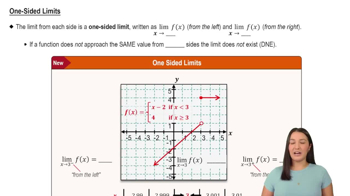
Limits at Infinity

Limits at infinity involve evaluating the behavior of a function as the variable approaches infinity. This concept is crucial for understanding how functions behave for very large values, often simplifying expressions by focusing on the highest degree terms in polynomials or rational functions.
Recommended video:
05:50
One-Sided Limits

Dominant Terms

In the context of limits, dominant terms are the terms in a polynomial or rational expression that have the highest degree and thus dictate the behavior of the function as the variable approaches infinity. Identifying these terms allows for simplification of the limit calculation, as lower degree terms become negligible.
Recommended video:
2:02
Simplifying Trig Expressions Example 1

Rational Functions

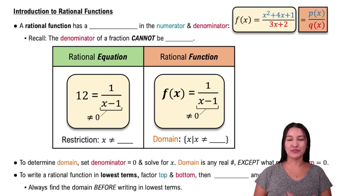
A rational function is a ratio of two polynomials. Understanding the properties of rational functions, including their limits, is essential for solving limit problems. The behavior of rational functions at infinity often depends on the degrees of the numerator and denominator, which can lead to finite limits, infinite limits, or limits that do not exist.
Recommended video:
6:04
Intro to Rational Functions