Ch. 2 - Limits
Briggs - Calculus: Early Transcendentals 3rd Edition
Briggs3rd EditionCalculus: Early TranscendentalsISBN: 9780136847243Not the one you use?Change textbook
Chapter 2, Problem 20

Determine the following limits. 
lim x→−∞ (5 + 100/x + sin4 x3 / x2)

Verified step by step guidance
1
Identify the limit expression: \( \lim_{x \to -\infty} \left( 5 + \frac{100}{x} + \frac{\sin^4(x^3)}{x^2} \right) \).
Recognize that as \( x \to -\infty \), the term \( \frac{100}{x} \) approaches 0 because the numerator is constant and the denominator grows without bound.
Consider the term \( \frac{\sin^4(x^3)}{x^2} \): since \( \sin(x^3) \) is bounded between -1 and 1, \( \sin^4(x^3) \) is also bounded between 0 and 1.
As \( x \to -\infty \), the denominator \( x^2 \) grows without bound, making \( \frac{\sin^4(x^3)}{x^2} \) approach 0.
Combine the results: the limit simplifies to \( 5 + 0 + 0 = 5 \), so the limit is 5.

Verified video answer for a similar problem:

This video solution was recommended by our tutors as helpful for the problem above.
Video duration:
5m
Was this helpful?

Key Concepts

Here are the essential concepts you must grasp in order to answer the question correctly.

Limits at Infinity

Limits at infinity involve evaluating the behavior of a function as the input approaches positive or negative infinity. In this context, we analyze how each term in the function behaves as x approaches negative infinity, which helps determine the overall limit.
Recommended video:
05:50
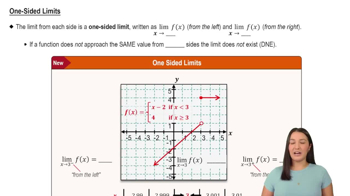
One-Sided Limits

Dominant Terms

In limit problems, dominant terms are those that have the most significant impact on the function's value as x approaches a certain point. For large values of x (positive or negative), terms with higher powers of x typically dominate, while lower power terms and constants become negligible.
Recommended video:
2:02
Simplifying Trig Expressions Example 1

Trigonometric Limits

Trigonometric limits involve understanding the behavior of trigonometric functions as their arguments approach certain values. In this case, the term sin^4(x^3) oscillates between 0 and 1, but its contribution diminishes when divided by x^2 as x approaches negative infinity.
Recommended video:
6:04
Introduction to Trigonometric Functions