Ch. 11 - Power Series
Briggs - Calculus: Early Transcendentals 3rd Edition
Briggs3rd EditionCalculus: Early TranscendentalsISBN: 9780136847243Not the one you use?Change textbook
Chapter 11, Problem 11.3.53

Working with binomial series Use properties of power series, substitution, and factoring to find the first four nonzero terms of the Maclaurin series for the following functions. Give the interval of convergence for the new series (Theorem 11.4 is useful). Use the Maclaurin series


√(1 + x) = 1 + x/2 − x²/8 + x³/16 − ⋯, −1 ≤ x ≤ 1.


√(9 − 9x)

Verified step by step guidance
1
Start with the given Maclaurin series for \( \sqrt{1 + x} \): \[ \sqrt{1 + x} = 1 + \frac{x}{2} - \frac{x^{2}}{8} + \frac{x^{3}}{16} - \cdots, \quad -1 \leq x \leq 1. \]
Rewrite the function \( \sqrt{9 - 9x} \) by factoring out 9 inside the square root: \[ \sqrt{9 - 9x} = \sqrt{9(1 - x)} = 3 \sqrt{1 - x}. \]
Express \( \sqrt{1 - x} \) in terms of the known series for \( \sqrt{1 + x} \) by substituting \( x \) with \( -x \): \[ \sqrt{1 - x} = 1 - \frac{x}{2} - \frac{x^{2}}{8} - \frac{x^{3}}{16} - \cdots. \] (Note the alternating signs come from substituting \( x \) by \( -x \) in the original series.)
Multiply the series for \( \sqrt{1 - x} \) by 3 to get the series for \( \sqrt{9 - 9x} \): \[ 3 \left(1 - \frac{x}{2} - \frac{x^{2}}{8} - \frac{x^{3}}{16} - \cdots \right) = 3 - \frac{3x}{2} - \frac{3x^{2}}{8} - \frac{3x^{3}}{16} - \cdots. \]
Determine the interval of convergence by considering the substitution \( x \to -x \) in the original interval \( -1 \leq x \leq 1 \). Since the original series converges for \( |x| \leq 1 \), the new series converges for \( | -x | \leq 1 \), which simplifies to \( |x| \leq 1 \).

Verified video answer for a similar problem:

This video solution was recommended by our tutors as helpful for the problem above.
Video duration:
3m
Was this helpful?

Key Concepts

Here are the essential concepts you must grasp in order to answer the question correctly.

Maclaurin Series and Power Series Expansion

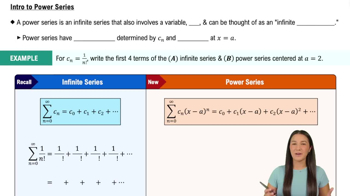
A Maclaurin series is a special case of a Taylor series expanded at x = 0, representing a function as an infinite sum of powers of x. It allows approximation of functions near zero by polynomials. Understanding how to write and manipulate these series is essential for finding terms of the expansion for given functions.
Recommended video:
05:58
Intro to Power Series

Substitution and Factoring in Power Series

Substitution involves replacing the variable in a known power series with an expression to find a new series. Factoring helps rewrite functions into forms compatible with known expansions. These techniques enable transforming the given function into a form where the Maclaurin series of √(1 + x) can be applied.
Recommended video:
05:58
Intro to Power Series

Interval of Convergence and Theorem 11.4

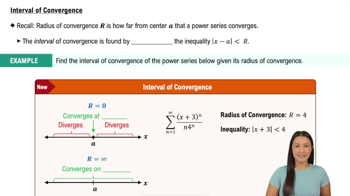
The interval of convergence defines where a power series converges to the function it represents. Theorem 11.4 (usually about radius and interval of convergence) helps determine this interval after substitution. Knowing how to find and interpret this interval ensures the series accurately represents the function within a specific domain.
Recommended video:
08:44
Interval of Convergence
Related Practice
Textbook Question

Functions to power series Find power series representations centered at 0 for the following functions using known power series. Give the interval of convergence for the resulting series.

f(x) = ln √(1 − x²)

1
views

Textbook Question

Combining power series Use the power series representation


f(x ) =ln (1 − x) = −∑ₖ₌₁∞ xᵏ/k, for −1 ≤ x < 1,


to find the power series for the following functions (centered at 0). Give the interval of convergence of the new series.


f(3x) = ln (1 − 3x)

Textbook Question

How would you approximate e⁻⁰ᐧ⁶ using the Taylor series for eˣ?

1
views
Textbook Question

Is ∑ₖ₌₀ ∞ (5x − 20)ᵏ a power series? If so, find the center a of the power series and state a formula for the coefficients cₖ of the power series.

1
views
Textbook Question

Use of Tech Linear and quadratic approximation


a. Find the linear approximating polynomial for the following functions centered at the given point a.


b. Find the quadratic approximating polynomial for the following functions centered at a.


c Use the polynomials obtained in parts (a) and (b) to approximate the given quantity.


f(x)=e⁻²ˣ, a=0; approximate e⁻⁰ᐧ².

Textbook Question

Exponential function In Section 11.3, we show that the power series for the exponential function centered at 0 is


eˣ = ∑ₖ₌₀∞ (xᵏ)/k!, for −∞ < x < ∞


Use the methods of this section to find the power series centered at 0 for the following functions. Give the interval of convergence for the resulting series.


f(x) = x²eˣ

1
views