Ch. 11 - Power Series
Briggs - Calculus: Early Transcendentals 3rd Edition
Briggs3rd EditionCalculus: Early TranscendentalsISBN: 9780136847243Not the one you use?Change textbook
Chapter 11, Problem 11.1.71b

{Use of Tech} Small argument approximations Consider the following common approximations when x is near zero. 


a. Estimate f(0.1) and give a bound on the error in the approximation.


f(x) = tan⁻¹ x ≈ x

Verified step by step guidance
1
Identify the function and the approximation given: the function is \(f(x) = \tan^{-1}(x)\) and the approximation near zero is \(f(x) \approx x\).
Recall that the approximation \(\tan^{-1}(x) \approx x\) comes from the first term of the Taylor series expansion of \(\tan^{-1}(x)\) around \(x=0\).
To estimate \(f(0.1)\) using the approximation, substitute \(x=0.1\) into the approximation: \(f(0.1) \approx 0.1\).
To find a bound on the error, use the Lagrange form of the remainder for the Taylor series. The error term after the linear approximation is given by \(R_2 = \frac{f''(c)}{2} x^2\) for some \(c\) between 0 and 0.1.
Calculate the second derivative of \(f(x) = \tan^{-1}(x)\), which is \(f''(x) = -\frac{2x}{(1+x^2)^2}\). Then find the maximum absolute value of \(f''(c)\) on the interval \([0, 0.1]\) to bound the error \(|R_2| \leq \frac{\max|f''(c)|}{2} (0.1)^2\).

Verified video answer for a similar problem:

This video solution was recommended by our tutors as helpful for the problem above.
Video duration:
5m
Was this helpful?

Key Concepts

Here are the essential concepts you must grasp in order to answer the question correctly.

Small Angle Approximations

Small angle approximations simplify functions near zero by replacing them with simpler expressions, such as approximating arctan(x) by x when x is close to zero. This helps estimate function values quickly without complex calculations.
Recommended video:
04:57
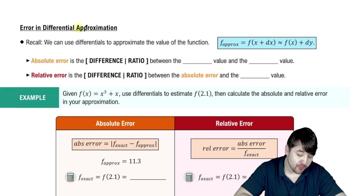
Determining Error and Relative Error

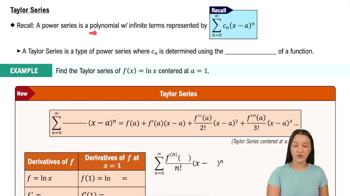
Taylor Series Expansion

The Taylor series expresses a function as an infinite sum of terms calculated from its derivatives at a point. For arctan(x), the first term is x, and higher-order terms provide corrections, allowing approximation and error estimation near zero.
Recommended video:
08:42
Taylor Series

Error Bound in Approximations

Error bounds quantify the maximum difference between the true function value and its approximation. Using the remainder term of the Taylor series, one can estimate how accurate the approximation f(x) ≈ x is for a given x, ensuring reliable results.
Recommended video:
04:57
Determining Error and Relative Error