Ch. 11 - Power Series
Briggs - Calculus: Early Transcendentals 3rd Edition
Briggs3rd EditionCalculus: Early TranscendentalsISBN: 9780136847243Not the one you use?Change textbook
Chapter 11, Problem 11.1.14

Use of Tech Linear and quadratic approximation


a. Find the linear approximating polynomial for the following functions centered at the given point a.


b. Find the quadratic approximating polynomial for the following functions centered at a.


c Use the polynomials obtained in parts (a) and (b) to approximate the given quantity.


f(x) = cos x, a = π/4; approximate cos (0.24π)

Verified step by step guidance
1
Step 1: Identify the function and the center point. Here, the function is \(f(x) = \cos x\) and the center point is \(a = \frac{\pi}{4}\).
Step 2: Find the value of the function and its derivatives at the center point \(a\). Calculate \(f(a) = \cos\left(\frac{\pi}{4}\right)\), the first derivative \(f'(x) = -\sin x\) and evaluate \(f'(a) = -\sin\left(\frac{\pi}{4}\right)\), and the second derivative \(f''(x) = -\cos x\) and evaluate \(f''(a) = -\cos\left(\frac{\pi}{4}\right)\).
Step 3: Write the linear approximating polynomial (the first-degree Taylor polynomial) centered at \(a\): \(L(x) = f(a) + f'(a)(x - a)\).
Step 4: Write the quadratic approximating polynomial (the second-degree Taylor polynomial) centered at \(a\): \(Q(x) = f(a) + f'(a)(x - a) + \frac{f''(a)}{2}(x - a)^2\).
Step 5: Use the polynomials \(L(x)\) and \(Q(x)\) to approximate \(\cos(0.24\pi)\) by substituting \(x = 0.24\pi\) into each polynomial.

Verified video answer for a similar problem:

This video solution was recommended by our tutors as helpful for the problem above.
Video duration:
2m
Was this helpful?

Key Concepts

Here are the essential concepts you must grasp in order to answer the question correctly.

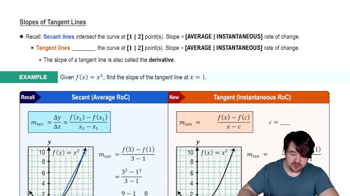
Linear Approximation (Tangent Line Approximation)

Linear approximation uses the tangent line at a point to estimate function values near that point. It is given by L(x) = f(a) + f'(a)(x - a), where f'(a) is the derivative at a. This method provides a simple, first-order estimate of the function close to a.
Recommended video:
05:13
Slopes of Tangent Lines

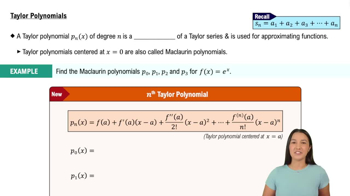
Quadratic Approximation (Second-Order Taylor Polynomial)

Quadratic approximation improves accuracy by including the second derivative term. The polynomial is Q(x) = f(a) + f'(a)(x - a) + (f''(a)/2)(x - a)^2, capturing curvature near a. It provides a better estimate than linear approximation for values near the center point.
Recommended video:
07:00
Taylor Polynomials

Using Approximations to Estimate Function Values

Once linear and quadratic polynomials are found, they can approximate function values at points near a. This avoids complex calculations of the original function, especially for transcendental functions like cosine. Comparing both approximations shows the improvement in accuracy.
Recommended video:
07:59
Estimating the Area Under a Curve Using Left Endpoints