
Textbook Question
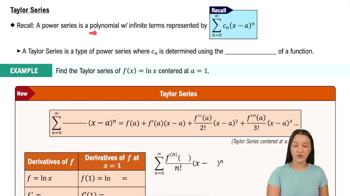
How are the Taylor polynomials for a function f centered at a related to the Taylor series of the function f centered at a?

 Verified step by step guidance
 08:42
08:42
 05:43
05:43 04:57
04:57How are the Taylor polynomials for a function f centered at a related to the Taylor series of the function f centered at a?
{Use of Tech} Remainders Let
f(x) = ∑ₖ₌₀∞ xᵏ = 1/(1−x) and Sₙ(x) = ∑ₖ₌₀ⁿ⁻¹ xᵏ
The remainder in truncating the power series after n terms is Rₙ = f(x) − Sₙ(x), which depends on x.
a. Show that Rₙ(x) = xⁿ /(1−x).
b. Graph the remainder function on the interval |x| < 1, for n=1, 2, and 3 . Discuss and interpret the graph. Where on the interval is |Rₙ(x)| largest? Smallest?
c. For fixed n, minimize |Rₙ(x)| with respect to x. Does the result agree with the observations in part (b)?
d. Let N(x) be the number of terms required to reduce |Rₙ(x)| to less than 10⁻⁶. Graph the function N(x) on the interval |x|<1.
Use of Tech Linear and quadratic approximation
a. Find the linear approximating polynomial for the following functions centered at the given point a.
b. Find the quadratic approximating polynomial for the following functions centered at a.
c Use the polynomials obtained in parts (a) and (b) to approximate the given quantity.
Find the Taylor polynomial p₃ centered at a=e for f(x)=ln x.
Combining power series Use the geometric series
f(x) = 1/(1-x) = ∑ₖ₌₀∞ xᵏ, for |x| < 1,
to find the power series representation for the following functions (centered at 0). Give the interval of convergence of the new series.
f(x³) = 1/(1 − x³)
Suppose you use a second-order Taylor polynomial centered at 0 to approximate a function f. What matching conditions are satisfied by the polynomial?
{Use of Tech} Graphing Taylor polynomials
a. Find the nth-order Taylor polynomials for the following functions centered at the given point a, for n=1 and n=2.
b. Graph the Taylor polynomials and the function.
f(x)=sin x, a=π/4