Ch. 11 - Power Series
Briggs - Calculus: Early Transcendentals 3rd Edition
Briggs3rd EditionCalculus: Early TranscendentalsISBN: 9780136847243Not the one you use?Change textbook
Chapter 11, Problem 11.4.38

{Use of Tech} Approximating definite integrals Use a Taylor series to approximate the following definite integrals. Retain as many terms as needed to ensure the error is less than 10⁻⁴.
∫₀⁰ᐧ² sin x² dx

Verified step by step guidance
1
Recognize that the integral involves the function \( \sin(x^2) \), which does not have an elementary antiderivative, making a Taylor series approximation a suitable approach.
Write the Taylor series expansion of \( \sin z \) around \( z=0 \): \[ \sin z = \sum_{n=0}^{\infty} (-1)^n \frac{z^{2n+1}}{(2n+1)!} = z - \frac{z^3}{3!} + \frac{z^5}{5!} - \cdots \] Substitute \( z = x^2 \) to get the series for \( \sin(x^2) \): \[ \sin(x^2) = x^2 - \frac{x^6}{3!} + \frac{x^{10}}{5!} - \cdots \]
Set up the integral of the series term-by-term from 0 to 0.2: \[ \int_0^{0.2} \sin(x^2) \, dx = \int_0^{0.2} \left( x^2 - \frac{x^6}{3!} + \frac{x^{10}}{5!} - \cdots \right) dx = \sum_{n=0}^{\infty} (-1)^n \frac{1}{(2n+1)!} \int_0^{0.2} x^{4n+2} \, dx \]
Integrate each term using the power rule: \[ \int_0^{0.2} x^{m} \, dx = \frac{(0.2)^{m+1}}{m+1} \] where \( m = 4n + 2 \). So each term becomes: \[ (-1)^n \frac{(0.2)^{4n+3}}{(2n+1)! (4n+3)} \]
Add terms of the series until the absolute value of the next term is less than \( 10^{-4} \) to ensure the error is within the required tolerance. Sum all included terms to approximate the value of the integral.

Verified video answer for a similar problem:

This video solution was recommended by our tutors as helpful for the problem above.
Video duration:
2m
Was this helpful?

Key Concepts

Here are the essential concepts you must grasp in order to answer the question correctly.

Taylor Series Expansion

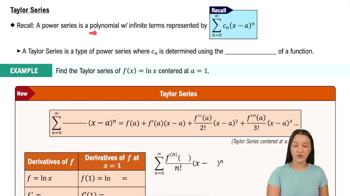
A Taylor series represents a function as an infinite sum of terms calculated from the function's derivatives at a single point. For sin(x²), expanding around x=0 allows approximation by polynomials, making integration manageable. Truncating the series after enough terms controls the approximation error.
Recommended video:
08:42
Taylor Series

Definite Integral Approximation Using Series

Integrating a function approximated by a Taylor series involves integrating each polynomial term individually over the given interval. This method simplifies complex integrals into sums of integrals of powers of x, which are straightforward to compute, enabling approximate evaluation of the definite integral.
Recommended video:
05:43
Definition of the Definite Integral

Error Estimation and Control

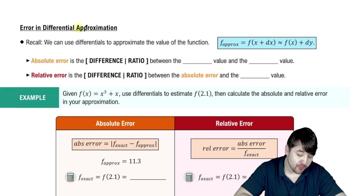
When truncating a Taylor series, the remainder term estimates the error between the true function and its polynomial approximation. Ensuring the error is less than 10⁻⁴ requires calculating or bounding this remainder, guiding how many terms to retain for a sufficiently accurate integral approximation.
Recommended video:
04:57
Determining Error and Relative Error
Related Practice
Textbook Question

Find a Taylor series for f centered at 2 given that f⁽ᵏ⁾(2)=1, for all nonnegative integers k.

Textbook Question

Use of Tech Linear and quadratic approximation


a. Find the linear approximating polynomial for the following functions centered at the given point a.


b. Find the quadratic approximating polynomial for the following functions centered at a.


c Use the polynomials obtained in parts (a) and (b) to approximate the given quantity.


f(x) = 8x^(3/2), a=1; approximate 8 ⋅ 1.1^(3/2)

Textbook Question

Taylor series Write out the first three nonzero terms of the Taylor series for the following functions centered at the given point a. Then write the series using summation notation.

ƒ(x) = tan⁻¹(4x), a = 0

Textbook Question

Use of Tech Linear and quadratic approximation


a. Find the linear approximating polynomial for the following functions centered at the given point a.


b. Find the quadratic approximating polynomial for the following functions centered at a.


c Use the polynomials obtained in parts (a) and (b) to approximate the given quantity.


Find the Taylor polynomials p₁, …, p₅ centered at a=0 for f(x)=e⁻ˣ

Textbook Question

{Use of Tech} Maximum error Use the remainder term to find a bound on the error in the following approximations on the given interval. Error bounds are not unique.


√(1+x) ≈ 1 + x/2 on [−0.1,0.1]

Textbook Question

Probability: tossing for a head The expected (average) number of tosses of a fair coin required to obtain the first head is ∑ₖ₌₁∞ k(1/2)ᵏ. Evaluate this series and determine the expected number of tosses. (Hint: Differentiate a geometric series.)