Ch. 11 - Power Series
Briggs - Calculus: Early Transcendentals 3rd Edition
Briggs3rd EditionCalculus: Early TranscendentalsISBN: 9780136847243Not the one you use?Change textbook
Chapter 11, Problem 11.4.41

{Use of Tech} Approximating definite integrals Use a Taylor series to approximate the following definite integrals. Retain as many terms as needed to ensure the error is less than 10⁻⁴.
∫₀⁰ᐧ³⁵ tan ⁻¹x dx

Verified step by step guidance
1
Identify the function to integrate: here it is \( f(x) = \tan^{-1}(x) \), also known as the inverse tangent or arctangent function.
Recall the Taylor series expansion of \( \tan^{-1}(x) \) centered at 0, which is \( \tan^{-1}(x) = \sum_{n=0}^{\infty} (-1)^n \frac{x^{2n+1}}{2n+1} = x - \frac{x^3}{3} + \frac{x^5}{5} - \frac{x^7}{7} + \cdots \).
Set up the integral of the Taylor series term-by-term from 0 to 0.35: \( \int_0^{0.35} \tan^{-1}(x) \, dx = \int_0^{0.35} \sum_{n=0}^{\infty} (-1)^n \frac{x^{2n+1}}{2n+1} \, dx = \sum_{n=0}^{\infty} (-1)^n \frac{1}{2n+1} \int_0^{0.35} x^{2n+1} \, dx \).
Integrate each term: \( \int_0^{0.35} x^{2n+1} \, dx = \frac{(0.35)^{2n+2}}{2n+2} \). Substitute back to get the series approximation for the integral: \( \sum_{n=0}^{\infty} (-1)^n \frac{(0.35)^{2n+2}}{(2n+1)(2n+2)} \).
Determine how many terms to keep by estimating the remainder (error) term of the alternating series to ensure the error is less than \( 10^{-4} \). Stop adding terms once the absolute value of the next term is smaller than \( 10^{-4} \).

Verified video answer for a similar problem:

This video solution was recommended by our tutors as helpful for the problem above.
Video duration:
2m
Was this helpful?

Key Concepts

Here are the essential concepts you must grasp in order to answer the question correctly.

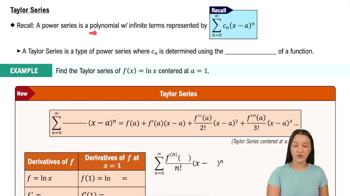
Taylor Series Expansion

A Taylor series represents a function as an infinite sum of terms calculated from the function's derivatives at a single point. It allows approximation of functions like arctan(x) by polynomials, which are easier to integrate. The accuracy improves as more terms are included.
Recommended video:
08:42
Taylor Series

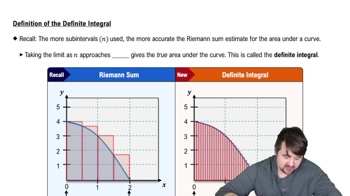
Definite Integral Approximation Using Series

Integrating a function approximated by its Taylor series term-by-term converts the integral into a sum of integrals of polynomials. This method simplifies evaluating definite integrals, especially when the exact integral is difficult to find analytically.
Recommended video:
05:43
Definition of the Definite Integral

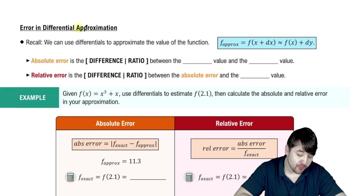
Error Estimation and Convergence Criteria

When approximating with Taylor series, it is crucial to estimate the remainder (error) to ensure the approximation meets a desired accuracy, here less than 10⁻⁴. Understanding convergence and bounding the error term guarantees the approximation's reliability.
Recommended video:
04:57
Determining Error and Relative Error