Ch. 11 - Power Series
Briggs - Calculus: Early Transcendentals 3rd Edition
Briggs3rd EditionCalculus: Early TranscendentalsISBN: 9780136847243Not the one you use?Change textbook
Chapter 11, Problem 11.3.11b

Taylor series and interval of convergence


b. Write the power series using summation notation.


f(x) = e⁻ˣ, a=0

Verified step by step guidance
1
Recall the Taylor series expansion of a function \( f(x) \) about \( a = 0 \) (also called the Maclaurin series) is given by: \[ \displaystyle f(x) = \sum_{n=0}^{\infty} \frac{f^{(n)}(0)}{n!} x^n \] where \( f^{(n)}(0) \) is the \( n \)-th derivative of \( f \) evaluated at 0.
Identify the function given: \( f(x) = e^{-x} \). The derivatives of \( e^{-x} \) follow a pattern because the derivative of \( e^{-x} \) is \( -e^{-x} \). Specifically, \[ \begin{cases} f(x) = e^{-x} \\ f'(x) = -e^{-x} \\ f''(x) = e^{-x} \\ f^{(3)}(x) = -e^{-x} \\ \vdots \end{cases} \]
Evaluate the \( n \)-th derivative at \( x=0 \): \[ \displaystyle f^{(n)}(0) = (-1)^n e^{0} = (-1)^n \] since \( e^{0} = 1 \).
Substitute \( f^{(n)}(0) = (-1)^n \) into the Taylor series formula to write the power series in summation notation: \[ \displaystyle e^{-x} = \sum_{n=0}^{\infty} \frac{(-1)^n}{n!} x^n \]
This summation notation represents the power series expansion of \( e^{-x} \) centered at \( a=0 \).

Verified video answer for a similar problem:

This video solution was recommended by our tutors as helpful for the problem above.
Video duration:
1m
Was this helpful?

Key Concepts

Here are the essential concepts you must grasp in order to answer the question correctly.

Taylor Series Expansion

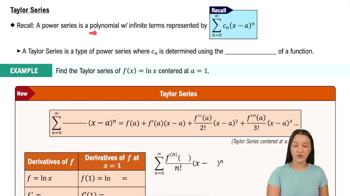
A Taylor series represents a function as an infinite sum of terms calculated from the derivatives of the function at a single point. For a function f(x) centered at a, the series is given by summing (f⁽ⁿ⁾(a)/n!) * (x - a)ⁿ, where n ranges from 0 to infinity. This allows approximation of functions using polynomials.
Recommended video:
08:42
Taylor Series

Power Series and Summation Notation

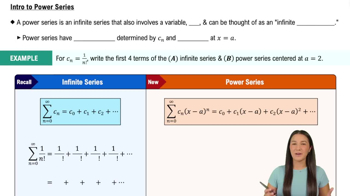
A power series is an infinite series of the form Σ cₙ(x - a)ⁿ, where cₙ are coefficients and a is the center. Summation notation (Σ) concisely expresses this infinite sum, making it easier to write and manipulate series. Writing the Taylor series in summation form clarifies the pattern of coefficients and powers.
Recommended video:
05:58
Intro to Power Series

Interval of Convergence

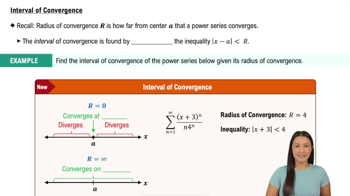
The interval of convergence is the set of x-values for which a power series converges to a finite value. It is found by applying convergence tests like the ratio test. Understanding this interval is crucial because the Taylor series only accurately represents the function within this range.
Recommended video:
08:44
Interval of Convergence