
Ch. 11 - Power Series
Briggs - Calculus: Early Transcendentals 3rd Edition
Briggs3rd EditionCalculus: Early TranscendentalsISBN: 9780136847243Not the one you use?Change textbook
Chapter 11, Problem 11.3.21a

Taylor series and interval of convergence


a. Use the definition of a Taylor/Maclaurin series to find the first four nonzero terms of the Taylor series for the given function centered at a.


f(x)=3ˣ, a=0

Verified step by step guidance
1
Recall that the Maclaurin series is a Taylor series centered at \(a=0\), and is given by the formula: \[f(x) = \sum_{n=0}^{\infty} \frac{f^{(n)}(0)}{n!} x^n,\] where \(f^{(n)}(0)\) is the \(n\)-th derivative of \(f\) evaluated at 0.
Identify the function: \(f(x) = 3^x\). To find the Maclaurin series, we need to compute the derivatives of \(f(x)\) and evaluate them at \(x=0\).
Calculate the first four derivatives of \(f(x)\): - \(f(x) = 3^x\) - \(f'(x) = 3^x \ln(3)\) - \(f''(x) = 3^x (\ln(3))^2\) - \(f^{(3)}(x) = 3^x (\ln(3))^3\) - \(f^{(4)}(x) = 3^x (\ln(3))^4\)
Evaluate each derivative at \(x=0\): - \(f(0) = 3^0 = 1\) - \(f'(0) = 3^0 \ln(3) = \ln(3)\) - \(f''(0) = 3^0 (\ln(3))^2 = (\ln(3))^2\) - \(f^{(3)}(0) = 3^0 (\ln(3))^3 = (\ln(3))^3\)
Write the first four nonzero terms of the Maclaurin series using the formula: \[f(x) \approx f(0) + \frac{f'(0)}{1!} x + \frac{f''(0)}{2!} x^2 + \frac{f^{(3)}(0)}{3!} x^3.\] Substitute the values found in the previous step to express the series explicitly.

Verified video answer for a similar problem:

This video solution was recommended by our tutors as helpful for the problem above.
Video duration:
2m
Was this helpful?

Key Concepts

Here are the essential concepts you must grasp in order to answer the question correctly.

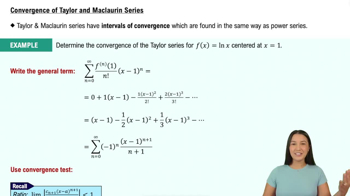
Taylor and Maclaurin Series

A Taylor series represents a function as an infinite sum of terms calculated from the derivatives of the function at a single point. When centered at zero, it is called a Maclaurin series. Each term involves the nth derivative evaluated at the center, multiplied by (x - a)^n and divided by n!.
Recommended video:
08:26
Convergence of Taylor & Maclaurin Series

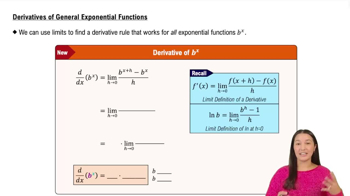
Derivatives of Exponential Functions

To find the Taylor series of f(x) = 3^x, you need to compute its derivatives at the center point. The derivative of an exponential function a^x is a^x times the natural logarithm of a. This pattern repeats for higher-order derivatives, which is essential for determining the series coefficients.
Recommended video:
04:50
Derivatives of General Exponential Functions

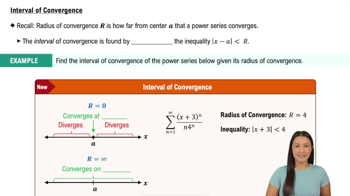
Interval of Convergence

The interval of convergence is the set of x-values for which the Taylor series converges to the function. For exponential functions like 3^x, the series converges for all real numbers, meaning the interval of convergence is (-∞, ∞). Understanding this ensures the series accurately represents the function within this domain.
Recommended video:
08:44
Interval of Convergence
Related Practice
Textbook Question

{Use of Tech} Bessel functions Bessel functions arise in the study of wave propagation in circular geometries (for example, waves on a circular drum head). They are conveniently defined as power series. One of an infinite family of Bessel functions is

J₀(x) = ∑ₖ₌₀∞ (−1)ᵏ/(2²ᵏ(k!)²) x²ᵏ

b. Find the radius and interval of convergence of the power series for J₀.

Textbook Question

Sine integral function The function Si(x) = ∫₀ˣ f(t) dt, where f(t) = {(sin t)/t if t ≠ 0, 1 if t = 0, is called the sine integral function.

a. Expand the integrand in a Taylor series centered at 0.

Textbook Question

{Use of Tech} Bessel functions Bessel functions arise in the study of wave propagation in circular geometries (for example, waves on a circular drum head). They are conveniently defined as power series. One of an infinite family of Bessel functions is

J₀(x) = ∑ₖ₌₀∞ (−1)ᵏ/(2²ᵏ(k!)²) x²ᵏ

a. Write out the first four terms of J₀.

Textbook Question

{Use of Tech} Small argument approximations Consider the following common approximations when x is near zero. 


b. Estimate f(0.2) and give a bound on the error in the approximation.


f(x) = sin ⁻¹ x ≈ x

1
views
Textbook Question

Taylor series and interval of convergence


a. Use the definition of a Taylor/Maclaurin series to find the first four nonzero terms of the Taylor series for the given function centered at a.


f(x) = (1 + x²)⁻¹, a = 0

Textbook Question

Explain why or why not Determine whether the following statements are true and give an explanation or counterexample.

The interval of convergence of the power series ∑ cₖ(x−3)ᵏ could be (−2,8).

1
views