Shifting power series If the power series f(x)=∑ cₖ xᵏ has an interval of convergence of |x|<R, what is the interval of convergence of the power series for f(x−a), where a ≠ 0 is a real number?

Ch. 11 - Power Series
Briggs3rd EditionCalculus: Early TranscendentalsISBN: 9780136847243Not the one you use?Change textbook
Chapter 11, Problem 11.3.39
Manipulating Taylor series Use the Taylor series in Table 11.5 to find the first four nonzero terms of the Taylor series for the following functions centered at 0.
{(eˣ−1)/x if x ≠ 1, 1 if x = 1
Verified step by step guidance1
Recall the Taylor series expansion of the exponential function centered at 0: \(e^{x} = \sum_{n=0}^{\infty} \frac{x^{n}}{n!} = 1 + x + \frac{x^{2}}{2!} + \frac{x^{3}}{3!} + \frac{x^{4}}{4!} + \cdots\).
Substitute this series into the given function \(\frac{e^{x} - 1}{x}\) for \(x \neq 0\). This gives: \(\frac{e^{x} - 1}{x} = \frac{\left(1 + x + \frac{x^{2}}{2!} + \frac{x^{3}}{3!} + \cdots \right) - 1}{x}\).
Simplify the numerator by canceling the 1's: \(\frac{x + \frac{x^{2}}{2!} + \frac{x^{3}}{3!} + \cdots}{x}\).
Divide each term in the numerator by \(x\): \(1 + \frac{x}{2!} + \frac{x^{2}}{3!} + \frac{x^{3}}{4!} + \cdots\).
Write out the first four nonzero terms explicitly: \(1 + \frac{x}{2} + \frac{x^{2}}{6} + \frac{x^{3}}{24}\).

Verified video answer for a similar problem:
This video solution was recommended by our tutors as helpful for the problem above.
Video duration:
1mWas this helpful?
Key Concepts
Here are the essential concepts you must grasp in order to answer the question correctly.
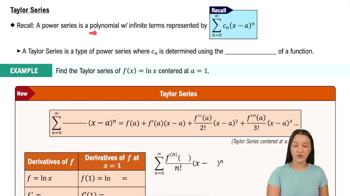
Taylor Series Expansion
A Taylor series represents a function as an infinite sum of terms calculated from the derivatives at a single point, usually centered at zero (Maclaurin series). It approximates functions locally and helps express complicated functions as polynomials, making analysis and computation easier.
Recommended video:
Taylor Series
Manipulating Series and Handling Indeterminate Forms
When a function involves expressions like (e^x - 1)/x, direct substitution at x=0 leads to an indeterminate form 0/0. Using the Taylor series for e^x, we expand numerator and denominator terms, then simplify by dividing series to find a valid series representation around zero.
Recommended video:
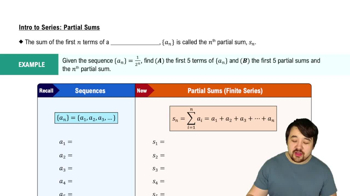
Intro to Series: Partial Sums
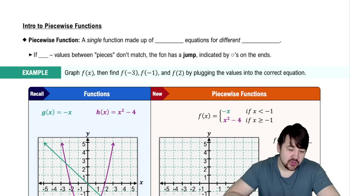
Piecewise Function and Continuity at a Point
The function is defined differently at x=1 and elsewhere, requiring careful consideration of limits and continuity. Understanding how the series expansion matches the function's value at the point ensures the series correctly represents the function, especially when the function is defined piecewise.
Recommended video:
Piecewise Functions
Related Practice
Textbook Question
Textbook Question
Series to functions Find the function represented by the following series, and find the interval of convergence of the series. (Not all these series are power series.)
∑ₖ₌₀∞ e⁻ᵏˣ
Textbook Question
Limits Evaluate the following limits using Taylor series.
lim ₓ→₀ (tan ⁻¹ x − x)/x³"
Textbook Question
Series to functions Find the function represented by the following series, and find the interval of convergence of the series. (Not all these series are power series.)
∑ₖ₌₀∞(√x − 2)ᵏ
1
views
Textbook Question
Radius of convergence Find the radius of convergence for the following power series.
∑ₖ₌₁∞ (1−cos (1/2ᵏ)) xᵏ
1
views
Textbook Question
Radius and interval of convergence Determine the radius and interval of convergence of the following power series.
∑ₖ₌₁∞ sinᵏ(1/k) xᵏ
1
views