Ch. 11 - Power Series
Briggs - Calculus: Early Transcendentals 3rd Edition
Briggs3rd EditionCalculus: Early TranscendentalsISBN: 9780136847243Not the one you use?Change textbook
Chapter 11, Problem 11.3.35

Manipulating Taylor series Use the Taylor series in Table 11.5 to find the first four nonzero terms of the Taylor series for the following functions centered at 0.


ln (1 + x²)

Verified step by step guidance
1
Recall the Taylor series expansion for \( \ln(1+x) \) centered at 0, which is given by: \[ \ln(1+x) = \sum_{n=1}^{\infty} (-1)^{n+1} \frac{x^n}{n} = x - \frac{x^2}{2} + \frac{x^3}{3} - \frac{x^4}{4} + \cdots \] This is the series you will manipulate to find the series for \( \ln(1+x^2) \).
Substitute \( x^2 \) in place of \( x \) in the series for \( \ln(1+x) \). This gives: \[ \ln(1+x^2) = x^2 - \frac{(x^2)^2}{2} + \frac{(x^2)^3}{3} - \frac{(x^2)^4}{4} + \cdots \] which simplifies to: \[ \ln(1+x^2) = x^2 - \frac{x^4}{2} + \frac{x^6}{3} - \frac{x^8}{4} + \cdots \]
Identify the first four nonzero terms from the series after substitution. These terms correspond to the powers of \( x \) with nonzero coefficients in the expansion.
Write out explicitly the first four nonzero terms of the Taylor series for \( \ln(1+x^2) \) centered at 0, using the simplified powers and coefficients from the previous step.
Verify that the series is centered at 0 and that the terms are ordered by increasing powers of \( x \). This confirms the correctness of the Taylor series expansion for \( \ln(1+x^2) \).

Verified video answer for a similar problem:

This video solution was recommended by our tutors as helpful for the problem above.
Video duration:
2m
Was this helpful?

Key Concepts

Here are the essential concepts you must grasp in order to answer the question correctly.

Taylor Series Expansion

A Taylor series represents a function as an infinite sum of terms calculated from the derivatives at a single point, usually centered at zero (Maclaurin series). It approximates functions locally and is useful for expressing complex functions as polynomials.
Recommended video:
08:42
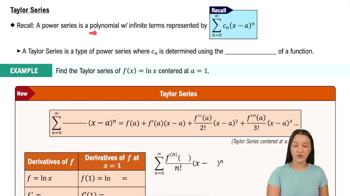
Taylor Series

Manipulating Known Series

To find the Taylor series of a new function, you can use known series expansions and apply algebraic operations like substitution, multiplication, or composition. For example, substituting x² into the series for ln(1 + x) helps find the series for ln(1 + x²).
Recommended video:
06:00
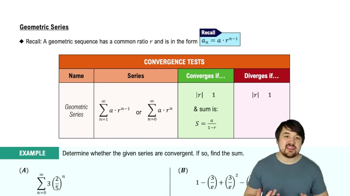
Geometric Series

Identifying Nonzero Terms

When expanding a series, it is important to identify and list the first few nonzero terms, as some terms may vanish due to the function's structure or substitution. This ensures the approximation captures the function's behavior accurately near the center.
Recommended video:
05:44
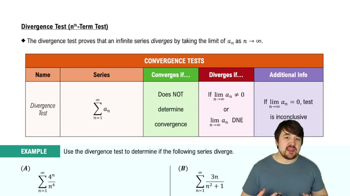
Divergence Test (nth Term Test)