Ch. 11 - Power Series
Briggs - Calculus: Early Transcendentals 3rd Edition
Briggs3rd EditionCalculus: Early TranscendentalsISBN: 9780136847243Not the one you use?Change textbook
Chapter 11, Problem 11.1.65d

Explain why or why not Determine whether the following statements are true and give an explanation or counterexample.
d. Suppose f'' is continuous on an interval that contains a, where f has an inflection point at a. Then the second−order Taylor polynomial for f at a is linear.

Verified step by step guidance
1
Recall that an inflection point at \(x = a\) means the concavity of the function changes at \(a\), which implies that the second derivative \(f''(a) = 0\) if \(f''\) is continuous around \(a\).
The second-order Taylor polynomial for \(f\) at \(a\) is given by: \[T_2(x) = f(a) + f'(a)(x - a) + \frac{f''(a)}{2}(x - a)^2\]
Since \(f''(a) = 0\) at the inflection point, the quadratic term in the Taylor polynomial disappears, leaving: \[T_2(x) = f(a) + f'(a)(x - a)\]
This polynomial is linear in \((x - a)\) because it only contains terms up to the first power of \((x - a)\).
Therefore, the second-order Taylor polynomial at an inflection point where \(f''\) is continuous is indeed linear, confirming the statement.

Verified video answer for a similar problem:

This video solution was recommended by our tutors as helpful for the problem above.
Video duration:
1m
Was this helpful?

Key Concepts

Here are the essential concepts you must grasp in order to answer the question correctly.

Inflection Point

An inflection point of a function f is a point where the concavity changes, meaning f'' changes sign. At this point, the second derivative f''(a) is typically zero or undefined, indicating a transition between concave up and concave down behavior.
Recommended video:
04:50
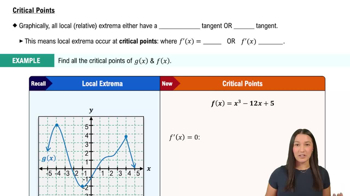
Critical Points

Second-Order Taylor Polynomial

The second-order Taylor polynomial of a function f at a point a approximates f near a using terms up to the second derivative: P_2(x) = f(a) + f'(a)(x - a) + (f''(a)/2)(x - a)^2. Its degree depends on whether f''(a) is zero or not.
Recommended video:
07:00
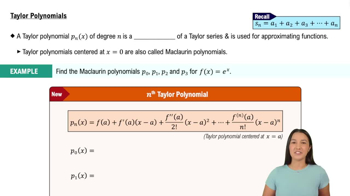
Taylor Polynomials

Continuity of the Second Derivative

If f'' is continuous near a, then f''(a) exists and is finite. For an inflection point at a with continuous f'', f''(a) = 0, which affects the form of the Taylor polynomial by eliminating the quadratic term, making it linear.
Recommended video:
06:02
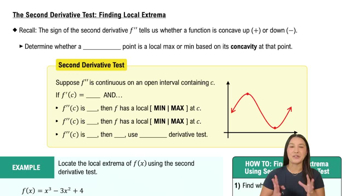
The Second Derivative Test: Finding Local Extrema
Related Practice
Textbook Question

Explain why or why not Determine whether the following statements are true and give an explanation or counterexample.

e. The Taylor series for an even function centered at 0 has only even powers of x.

Textbook Question

{Use of Tech} Fresnel integrals The theory of optics gives rise to the two Fresnel integrals

S(x) = ∫₀ˣ sin t² dt and C(x) = ∫₀ˣ cos t² dt

e. How many terms of the Maclaurin series are required to approximate C(−0.25) with an error no greater than 10⁻⁶?

Textbook Question

{Use of Tech} Fresnel integrals The theory of optics gives rise to the two Fresnel integrals

S(x) = ∫₀ˣ sin t² dt and C(x) = ∫₀ˣ cos t² dt

d. How many terms of the Maclaurin series are required to approximate S(0.05) with an error no greater than 10⁻⁴?

Textbook Question

Explain why or why not Determine whether the following statements are true and give an explanation or counterexample.

d. If p(x) is the Taylor series for f centered at 0, then p(x−1) is the Taylor series for f centered at 1.

Textbook Question

Matching functions with polynomials Match functions a–f with Taylor polynomials A–F (all centered at 0). Give reasons for your choices.


f. e⁻²ˣ


A. p₂(x)= 1 + 2x + 2x²

B. p₂(x) = 1 − 6x + 24x²

C. p₂(x) = 1 + x − x²/2

D. p₂(x) = 1 − 2x + 4x²

E. p₂(x) = 1 − x + (3/2)x²

F. p₂(x) = 1 − 2x + 2x²

1
views
Textbook Question

Explain why or why not Determine whether the following statements are true and give an explanation or counterexample.


If f(x)=∑ₖ₌₀∞ cₖ xᵏ=0, for all x on an interval (−a, a), then cₖ = 0, for all k.

1
views