
Ch. 11 - Power Series
Briggs - Calculus: Early Transcendentals 3rd Edition
Briggs3rd EditionCalculus: Early TranscendentalsISBN: 9780136847243Not the one you use?Change textbook
Chapter 11, Problem 11.1.65c

Explain why or why not Determine whether the following statements are true and give an explanation or counterexample.


c. Only even powers of x appear in the nth−order Taylor polynomial for f(x)=√(1+x²) centered at 0.

Verified step by step guidance
1
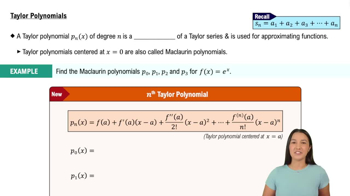
Recall that the nth-order Taylor polynomial of a function \(f(x)\) centered at 0 (Maclaurin polynomial) is given by: \[T_n(x) = \sum_{k=0}^n \frac{f^{(k)}(0)}{k!} x^k,\] where \(f^{(k)}(0)\) is the \(k\)th derivative of \(f\) evaluated at 0.
Consider the function \(f(x) = \sqrt{1 + x^2}\). Notice that \(f(x)\) is an even function because \(f(-x) = \sqrt{1 + (-x)^2} = \sqrt{1 + x^2} = f(x)\).
Since \(f(x)\) is even, its Taylor series expansion around 0 will contain only even powers of \(x\). This is a general property: the Taylor series of an even function centered at 0 contains only even powers, and the Taylor series of an odd function contains only odd powers.
To confirm this, you can compute the first few derivatives of \(f(x)\) at 0 and observe that all derivatives of odd order vanish at 0, i.e., \(f^{(1)}(0) = 0\), \(f^{(3)}(0) = 0\), etc., which means the coefficients of odd powers are zero.
Therefore, the nth-order Taylor polynomial for \(f(x) = \sqrt{1 + x^2}\) centered at 0 contains only even powers of \(x\), making the statement true.

Verified video answer for a similar problem:

This video solution was recommended by our tutors as helpful for the problem above.
Video duration:
4m
Was this helpful?

Key Concepts

Here are the essential concepts you must grasp in order to answer the question correctly.

Taylor Polynomial

A Taylor polynomial approximates a function near a specific point using derivatives at that point. The nth-order Taylor polynomial includes terms up to the nth derivative, expressed as powers of (x - a), where a is the center. It provides a polynomial approximation that matches the function's behavior locally.
Recommended video:
07:00
Taylor Polynomials

Even and Odd Functions

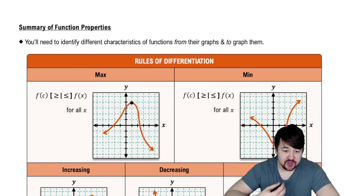
An even function satisfies f(-x) = f(x), resulting in Taylor expansions with only even powers of x. An odd function satisfies f(-x) = -f(x), leading to only odd powers in its expansion. Understanding the symmetry of a function helps predict which powers appear in its Taylor series.
Recommended video:
06:21
Properties of Functions

Derivatives of Composite Functions

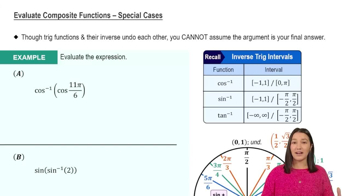
Calculating Taylor polynomials often requires finding derivatives of composite functions like f(x) = √(1 + x²). Using the chain rule and recognizing patterns in derivatives helps determine which terms vanish or remain, influencing the presence of even or odd powers in the polynomial.
Recommended video:
3:48
Evaluate Composite Functions - Special Cases
Related Practice
Textbook Question

Explain why or why not Determine whether the following statements are true and give an explanation or counterexample.

c. If f has a Taylor series that converges only on (−2,2), then f(x²) has a Taylor series that also converges only on (−2,2).

Textbook Question

Taylor series and interval of convergence


c. Determine the interval of convergence of the series.


f(x) = cosh 3x, a = 0

1
views
Textbook Question

{Use of Tech} Bessel functions Bessel functions arise in the study of wave propagation in circular geometries (for example, waves on a circular drum head). They are conveniently defined as power series. One of an infinite family of Bessel functions is

J₀(x) = ∑ₖ₌₀∞ (−1)ᵏ/(2²ᵏ(k!)²) x²ᵏ

c. Differentiate J₀ twice and show (by keeping terms through x⁶) that J₀ satisfies the equation x² y′′(x) + xy′(x) + x²y(x)=0.

Textbook Question

{Use of Tech} Fresnel integrals The theory of optics gives rise to the two Fresnel integrals

S(x) = ∫₀ˣ sin t² dt and C(x) = ∫₀ˣ cos t² dt

c. Use the polynomials in part (b) to approximate S(0.05) and C(−0.25).

Textbook Question

Matching functions with polynomials Match functions a–f with Taylor polynomials A–F (all centered at 0). Give reasons for your choices.


d. 1/(1 + 2x)


A. p₂(x)= 1 + 2x + 2x²

B. p₂(x) = 1 − 6x + 24x²

C. p₂(x) = 1 + x − x²/2

D. p₂(x) = 1 − 2x + 4x²

E. p₂(x) = 1 − x + (3/2)x²

F. p₂(x) = 1 − 2x + 2x²

Textbook Question

Explain why or why not Determine whether the following statements are true and give an explanation or counterexample.


If f(x)=∑ₖ₌₀∞ cₖ xᵏ=0, for all x on an interval (−a, a), then cₖ = 0, for all k.

1
views