
Ch. 11 - Power Series
Briggs - Calculus: Early Transcendentals 3rd Edition
Briggs3rd EditionCalculus: Early TranscendentalsISBN: 9780136847243Not the one you use?Change textbook
Chapter 11, Problem 11.2.42

Combining power series Use the geometric series


f(x) = 1/(1-x) = ∑ₖ₌₀∞ xᵏ, for |x| < 1,


to find the power series representation for the following functions (centered at 0). Give the interval of convergence of the new series.


g(x) = x³/(1 − x)

Verified step by step guidance
1
Recall the given geometric series formula: \[f(x) = \frac{1}{1 - x} = \sum_{k=0}^{\infty} x^{k}, \quad \text{for } |x| < 1.\] This series converges when the absolute value of \(x\) is less than 1.
To find the power series representation for \[g(x) = \frac{x^{3}}{1 - x},\] notice that it can be written as \[g(x) = x^{3} \cdot \frac{1}{1 - x}.\]
Substitute the power series for \[\frac{1}{1 - x}\] into the expression for \[g(x)\]: \[g(x) = x^{3} \sum_{k=0}^{\infty} x^{k}.\]
Use properties of exponents to combine the powers of \[x\] inside the summation: \[g(x) = \sum_{k=0}^{\infty} x^{k + 3} = \sum_{k=0}^{\infty} x^{k + 3}.\]
Rewrite the series with a new index if desired (for example, let \[n = k + 3\]) to express the series in standard form. The interval of convergence remains \[|x| < 1\] because multiplying by \[x^{3}\] does not affect convergence.

Verified video answer for a similar problem:

This video solution was recommended by our tutors as helpful for the problem above.
Video duration:
3m
Was this helpful?

Key Concepts

Here are the essential concepts you must grasp in order to answer the question correctly.

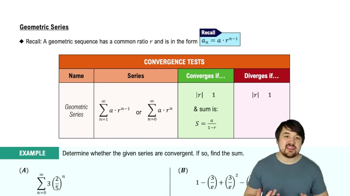
Geometric Series and Its Power Series Representation

A geometric series is a sum of the form ∑ x^k for k from 0 to infinity, which converges to 1/(1 - x) when |x| < 1. This fundamental series allows us to express many functions as power series by manipulating the variable or coefficients. Understanding this series is key to rewriting functions like g(x) in terms of power series.
Recommended video:
06:00
Geometric Series

Manipulating Power Series to Represent New Functions

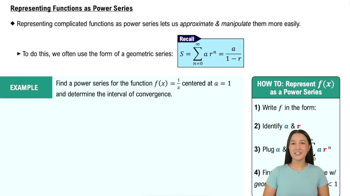
To find the power series of a function like g(x) = x³/(1 - x), we use substitution and multiplication on the known geometric series. Multiplying the entire series by x³ shifts the powers, resulting in a new series ∑ x^(k+3). This technique helps generate power series for more complex functions based on simpler known series.
Recommended video:
07:32
Representing Functions as Power Series

Interval of Convergence for Power Series

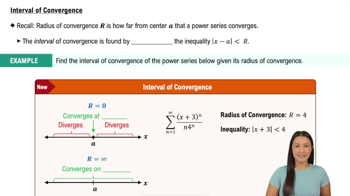
The interval of convergence is the set of x-values for which a power series converges. For the geometric series 1/(1 - x), the interval is |x| < 1. When manipulating the series (e.g., multiplying by x³), the interval of convergence remains the same unless the function introduces new singularities. Identifying this interval ensures the series representation is valid.
Recommended video:
08:44
Interval of Convergence
Related Practice
Textbook Question

Use of Tech Linear and quadratic approximation


a. Find the linear approximating polynomial for the following functions centered at the given point a.


b. Find the quadratic approximating polynomial for the following functions centered at a.


c Use the polynomials obtained in parts (a) and (b) to approximate the given quantity.


Find the Taylor polynomials p₁, p₂, and p₃ centered at a=1 for f(x)=x³.

Textbook Question

Representing functions by power series Identify the functions represented by the following power series.

∑ₖ₌₁∞ (x²ᵏ)/k

Textbook Question

{Use of Tech} Graphing Taylor polynomials


a. Find the nth-order Taylor polynomials for the following functions centered at the given point a, for n=1 and n=2.


b. Graph the Taylor polynomials and the function.


f(x)=sin x, a=π/4

Textbook Question

Limits Evaluate the following limits using Taylor series.

lim ₓ→₀ (eˣ − e⁻ˣ)/x

Textbook Question

Differentiating and integrating power series Find the power series representation for g centered at 0 by differentiating or integrating the power series for f (perhaps more than once). Give the interval of convergence for the resulting series.


g(x) = 2/(1 − 2x)² using f(x) = 1/(1 − 2x)

1
views
Textbook Question

Combining power series Use the power series representation


f(x ) =ln (1 − x) = −∑ₖ₌₁∞ xᵏ/k, for −1 ≤ x < 1,


to find the power series for the following functions (centered at 0). Give the interval of convergence of the new series.


p(x) = 2x⁶ ln(1 − x)