
Ch. 10 - Sequences and Infinite Series
Briggs - Calculus: Early Transcendentals 3rd Edition
Briggs3rd EditionCalculus: Early TranscendentalsISBN: 9780136847243Not the one you use?Change textbook
Chapter 10, Problem 10.2.89c

{Use of Tech} Drug Dosing
A patient takes 75 mg of a medication every 12 hours; 60% of the medication in the blood is eliminated every 12 hours.


c.Find the limit of the sequence. What is the physical meaning of this limit?

Verified step by step guidance
1
Identify the sequence that models the amount of medication in the blood just before each dose. Let \( a_n \) represent the amount of medication in the blood just before the \( n^{th} \) dose is taken.
Recognize that after each 12-hour period, 60% of the medication is eliminated, so 40% remains. This means the amount of medication remaining after elimination is \( 0.4 \times a_n \). Then, the patient takes an additional 75 mg, so the next term in the sequence is \( a_{n+1} = 0.4 \times a_n + 75 \).
Understand that this is a linear recurrence relation of the form \( a_{n+1} = r a_n + d \), where \( r = 0.4 \) and \( d = 75 \). To find the limit of the sequence as \( n \to \infty \), we look for the steady-state value \( L \) where \( a_{n+1} = a_n = L \).
Set up the equation for the limit: \( L = 0.4 L + 75 \). Solve this equation for \( L \) to find the long-term amount of medication in the blood just before taking a dose.
Interpret the physical meaning of the limit \( L \): it represents the equilibrium concentration of the medication in the blood, where the amount eliminated and the amount taken balance out, resulting in a stable level of medication over time.

Verified video answer for a similar problem:

This video solution was recommended by our tutors as helpful for the problem above.
Video duration:
2m
Was this helpful?

Key Concepts

Here are the essential concepts you must grasp in order to answer the question correctly.

Geometric Sequences and Series

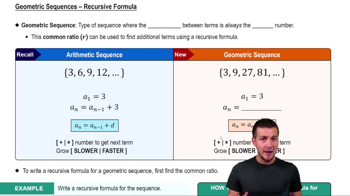
A geometric sequence is a sequence of numbers where each term is found by multiplying the previous term by a constant ratio. Understanding how to find the limit of such sequences is essential when analyzing repeated processes like drug dosing, where the amount changes by a fixed percentage over time.
Recommended video:
Guided course
04:18
Geometric Sequences - Recursive Formula

Limit of a Sequence

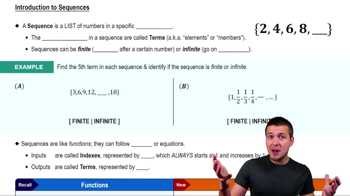
The limit of a sequence describes the value that the terms of the sequence approach as the number of terms goes to infinity. In drug dosing, this limit represents the steady-state concentration of the medication in the blood after many doses.
Recommended video:
Guided course
8:22
Introduction to Sequences

Pharmacokinetics and Drug Elimination

Pharmacokinetics studies how drugs are absorbed, distributed, metabolized, and eliminated by the body. The elimination rate (60% every 12 hours) affects the drug concentration over time, influencing the calculation of the steady-state level in repeated dosing.
Recommended video:
Guided course
05:59
Eliminating the Parameter
Related Practice
Textbook Question

41–44. {Use of Tech} Remainders and estimates Consider the following convergent series.


d. Find an interval in which the value of the series must lie if you approximate it using ten terms of the series.


43. ∑ (k = 1 to ∞) 1 / 3ᵏ

1
views
Textbook Question

72–75. {Use of Tech} Practical sequences

Consider the following situations that generate a sequence


c.Find a recurrence relation that generates the sequence.


Radioactive decay

A material transmutes 50% of its mass to another element every 10 years due to radioactive decay. Let Mₙ be the mass of the radioactive material at the end of the nᵗʰ decade, where the initial mass of the material is M₀ = 20g.

1
views
Textbook Question

Explain why or why not Determine whether the following statements are true and give an explanation or counterexample.


c. A series that converges conditionally must converge.

Textbook Question

27–34. Working with sequences Several terms of a sequence {aₙ}ₙ₌₁∞ are given.

c. Find an explicit formula for the nth term of the sequence.


{1, 2, 4, 8, 16, ......}

1
views
Textbook Question

Explain why or why not Determine whether the following statements are true and give an explanation or counterexample.

d. If ∑ aₖ diverges, then ∑ |aₖ| diverges.

Textbook Question

Explain why or why not Determine whether the following statements are true and give an explanation or counterexample.


d. The Ratio Test is always inconclusive when applied to ∑ aₖ, where aₖ is a nonzero rational function of k.