Ch. 10 - Sequences and Infinite Series
Briggs - Calculus: Early Transcendentals 3rd Edition
Briggs3rd EditionCalculus: Early TranscendentalsISBN: 9780136847243Not the one you use?Change textbook
Chapter 10, Problem 10.R.1g

Explain why or why not
Determine whether the following statements are true and give an explanation or counterexample.


g.The series ∑ (from k = 1 to ∞) (k² / (k² + 1)) converges.

Verified step by step guidance
1
Identify the general term of the series: \( a_k = \frac{k^2}{k^2 + 1} \).
Examine the behavior of \( a_k \) as \( k \to \infty \). Calculate the limit \( \lim_{k \to \infty} a_k = \lim_{k \to \infty} \frac{k^2}{k^2 + 1} \).
Since the degrees of numerator and denominator are the same, the limit is the ratio of the leading coefficients, which is \( 1 \). So, \( \lim_{k \to \infty} a_k = 1 \).
Recall the Divergence Test (also called the Test for Divergence): if \( \lim_{k \to \infty} a_k \neq 0 \), then the series \( \sum a_k \) diverges.
Because \( \lim_{k \to \infty} a_k = 1 \neq 0 \), the series \( \sum_{k=1}^\infty \frac{k^2}{k^2 + 1} \) does not converge; it diverges.

Verified video answer for a similar problem:

This video solution was recommended by our tutors as helpful for the problem above.
Video duration:
2m
Was this helpful?

Key Concepts

Here are the essential concepts you must grasp in order to answer the question correctly.

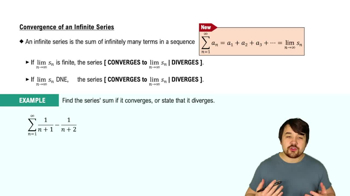
Definition of Series Convergence

A series converges if the sequence of its partial sums approaches a finite limit as the number of terms goes to infinity. If the partial sums do not approach a finite value, the series diverges. Understanding this helps determine whether the given infinite sum converges or not.
Recommended video:
06:52
Convergence of an Infinite Series

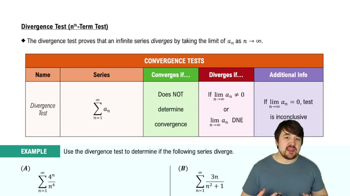
Term Test for Divergence

If the terms of a series do not approach zero as k approaches infinity, the series must diverge. This is a quick test to check convergence; if the limit of the general term is not zero, the series cannot converge.
Recommended video:
05:44
Divergence Test (nth Term Test)

Behavior of the General Term (k² / (k² + 1))

Analyzing the limit of the term k² / (k² + 1) as k approaches infinity shows it approaches 1, not zero. Since the terms do not tend to zero, this indicates the series ∑ (k² / (k² + 1)) diverges by the term test.
Recommended video:
06:11
Introduction to Riemann Sums
Related Practice
Textbook Question

89–90. {Use of Tech} Lower and upper bounds of a series

For each convergent series and given value of n, complete the following.


b. Find an upper bound for the remainder Rₙ.


89.∑ (from k = 1 to ∞)1 / k⁵ ;n = 5

Textbook Question

Building a tunnel — first scenario

A crew of workers is constructing a tunnel through a mountain. Understandably, the rate of construction decreases because rocks and earth must be removed a greater distance as the tunnel gets longer. Suppose each week the crew digs 0.95 of the distance it dug the previous week. In the first week, the crew constructed 100 m of tunnel.


a.How far does the crew dig in 10 weeks? 20 weeks? N weeks?

1
views
Textbook Question

Determine whether the following statements are true and give an explanation or counterexample.

c. The terms of the sequence of partial sums of the series ∑ aₖ approach 5/2, so the infinite series converges to 5/2.

Textbook Question

Explain why or why not

Determine whether the following statements are true and give an explanation or counterexample.


e.The sequence aₙ = n² / (n² + 1) converge.

1
views
Textbook Question

42–76. Convergence or divergence Use a convergence test of your choice to determine whether the following series converge.

∑ (from k = 1 to ∞)k√k / k³

Textbook Question

89–90. {Use of Tech} Lower and upper bounds of a series

For each convergent series and given value of n, complete the following.


c. Find lower and upper bounds (Lₙ and Uₙ respectively) for the exact value of the series.


89.∑ (from k = 1 to ∞)1 / k⁵ ;n = 5