
Textbook Question
Explain why or why not Determine whether the following statements are true and give an explanation or counterexample.
b. (2n)! / (2n − 1)! = 2n
2
views

 Verified step by step guidance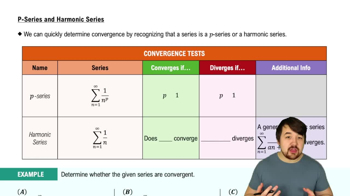
 04:30
04:30
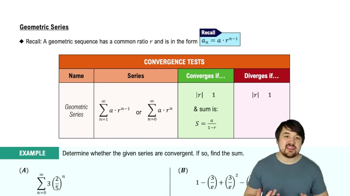 06:00 04:30
Explain why or why not Determine whether the following statements are true and give an explanation or counterexample.
b. (2n)! / (2n − 1)! = 2n
Explain why or why not
Determine whether the following statements are true and give an explanation or counterexample.
b.If a sequence of positive numbers converges, then the sequence is decreasing.
27–34. Working with sequences Several terms of a sequence {aₙ}ₙ₌₁∞ are given.
b. Find a recurrence relation that generates the sequence (supply the initial value of the index and the first term of the sequence).
{1, 3, 9, 27, 81, ......}
{Use of Tech} Periodic dosing
Many people take aspirin on a regular basis as a preventive measure for heart disease. Suppose a person takes 80 mg of aspirin every 24 hours. Assume aspirin has a half-life of 24 hours; that is, every 24 hours, half of the drug in the blood is eliminated.
b.Use a calculator to estimate this limit. In the long run, how much drug is in the person’s blood?
71. Evaluating an infinite series two ways
Evaluate the series
∑ (k = 1 to ∞) (4 / 3ᵏ – 4 / 3ᵏ⁺¹) two ways.
b. Use a geometric series argument with Theorem 10.8.
{Use of Tech} Fibonacci sequence
The famous Fibonacci sequence was proposed by Leonardo Pisano, also known as Fibonacci, in about A.D. 1200 as a model for the growth of rabbit populations.
It is given by the recurrence relation: fₙ₊₁ = fₙ + fₙ₋₁,for n = 1, 2, 3, … where f₀ = 1 and f₁ = 1. Each term of the sequence is the sum of its two predecessors.
b.Is the sequence bounded?