Ch. 10 - Sequences and Infinite Series
Briggs - Calculus: Early Transcendentals 3rd Edition
Briggs3rd EditionCalculus: Early TranscendentalsISBN: 9780136847243Not the one you use?Change textbook
Chapter 10, Problem 10.7.11

9–30. The Ratio and Root Tests Use the Ratio Test or the Root Test to determine whether the following series converge absolutely or diverge.
∑ (from k = 1 to ∞) ((-1)ᵏ⁺¹) × ((10k³ + k) / (9k³ + k + 1))ᵏ

Verified step by step guidance
1
Identify the general term of the series: \(a_k = (-1)^{k+1} \left( \frac{10k^3 + k}{9k^3 + k + 1} \right)^k\).
Since the series has terms raised to the power \(k\), the Root Test is a natural choice. Recall the Root Test uses the limit \(L = \lim_{k \to \infty} \sqrt[k]{|a_k|}\).
Calculate \(\sqrt[k]{|a_k|}\). Because of the absolute value, the \((-1)^{k+1}\) disappears, so \(\sqrt[k]{|a_k|} = \sqrt[k]{\left( \frac{10k^3 + k}{9k^3 + k + 1} \right)^k} = \frac{10k^3 + k}{9k^3 + k + 1}\).
Evaluate the limit \(L = \lim_{k \to \infty} \frac{10k^3 + k}{9k^3 + k + 1}\). To do this, divide numerator and denominator by \(k^3\) to simplify the expression.
Interpret the result of the limit \(L\): if \(L < 1\), the series converges absolutely; if \(L > 1\), the series diverges; if \(L = 1\), the Root Test is inconclusive.

Verified video answer for a similar problem:

This video solution was recommended by our tutors as helpful for the problem above.
Video duration:
3m
Was this helpful?

Key Concepts

Here are the essential concepts you must grasp in order to answer the question correctly.

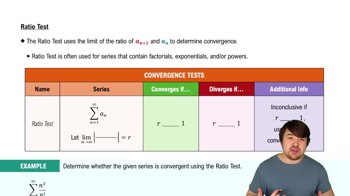
Ratio Test

The Ratio Test determines the convergence of a series by examining the limit of the absolute value of the ratio of consecutive terms. If this limit is less than 1, the series converges absolutely; if greater than 1, it diverges; if equal to 1, the test is inconclusive.
Recommended video:
05:35
Ratio Test

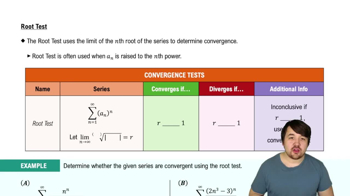
Root Test

The Root Test analyzes the nth root of the absolute value of the nth term of a series. If the limit of this root is less than 1, the series converges absolutely; if greater than 1, it diverges; if equal to 1, the test is inconclusive. It is especially useful for terms raised to the nth power.
Recommended video:
07:15
Root Test

Absolute Convergence

A series converges absolutely if the series of absolute values of its terms converges. Absolute convergence implies convergence regardless of term signs, which is important when applying tests like the Ratio or Root Test to series with alternating signs.
Recommended video:
07:51
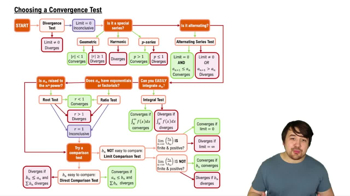
Choosing a Convergence Test