Ch. 10 - Sequences and Infinite Series
Briggs - Calculus: Early Transcendentals 3rd Edition
Briggs3rd EditionCalculus: Early TranscendentalsISBN: 9780136847243Not the one you use?Change textbook
Chapter 10, Problem 10.3.87g

87. Explain why or why not
Determine whether the following statements are true and give an explanation or counterexample.


g. Viewed as a function of r, the series 1 + r + r² + r³ + ⋯ takes on all values in the interval (1/2, ∞).

Verified step by step guidance
1
Recall the formula for the sum of an infinite geometric series \(S = 1 + r + r^2 + r^3 + \cdots\) when \(|r| < 1\), which is given by \(S = \frac{1}{1 - r}\).
Identify the domain of \(r\) for which the series converges: the series converges only if \(|r| < 1\).
Analyze the range of the sum \(S = \frac{1}{1 - r}\) as \(r\) varies within \((-1, 1)\): as \(r\) approaches 1 from below, \(S\) grows without bound towards \(+\infty\); as \(r\) approaches \(-1\) from above, \(S\) approaches \(\frac{1}{1 - (-1)} = \frac{1}{2}\).
Conclude that the sum \(S\) takes on all values in the interval \((\frac{1}{2}, \infty)\) as \(r\) varies in \((-1, 1)\), which is the domain of convergence.
Therefore, the statement is true if we consider \(r\) restricted to \((-1, 1)\), but false if \(r\) is allowed outside this interval since the series does not converge there.

Verified video answer for a similar problem:

This video solution was recommended by our tutors as helpful for the problem above.
Video duration:
4m
Was this helpful?

Key Concepts

Here are the essential concepts you must grasp in order to answer the question correctly.

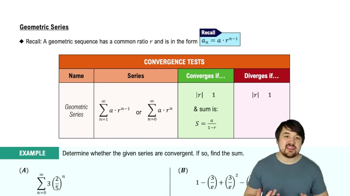
Geometric Series and Its Sum Formula

A geometric series is a sum of terms where each term is a constant ratio r times the previous term. For |r| < 1, the infinite series 1 + r + r² + r³ + ⋯ converges to 1/(1 - r). Understanding this formula is essential to analyze the values the series can take as a function of r.
Recommended video:
06:00
Geometric Series

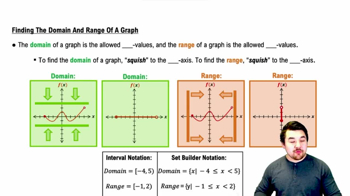
Domain and Range of the Sum Function

The sum function S(r) = 1/(1 - r) is defined for all r except r = 1, where it diverges. Its range depends on the values of r, especially considering convergence criteria. Analyzing the interval of r values that produce sums within (1/2, ∞) helps determine if the series covers that entire interval.
Recommended video:
5:10
Finding the Domain and Range of a Graph

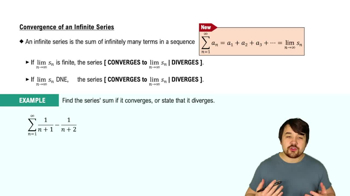
Convergence Criteria for Infinite Series

For an infinite geometric series to converge, the common ratio r must satisfy |r| < 1. If |r| ≥ 1, the series diverges and does not sum to a finite value. This criterion restricts the possible sums and is crucial when evaluating whether the series can take all values in a given interval.
Recommended video:
06:52
Convergence of an Infinite Series