
Textbook Question
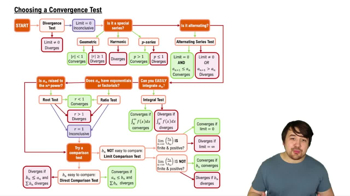
77–87. Absolute or conditional convergence
Determine whether the following series converge absolutely, converge conditionally, or diverge.
∑ (from k = 1 to ∞)(−1)ᵏk·e⁻ᵏ

 Verified step by step guidance
 07:51
07:51 07:51
07:51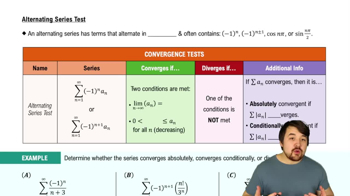 10:54
10:5477–87. Absolute or conditional convergence
Determine whether the following series converge absolutely, converge conditionally, or diverge.
∑ (from k = 1 to ∞)(−1)ᵏk·e⁻ᵏ
54–69. Telescoping series
For the following telescoping series, find a formula for the nth term of the sequence of partial sums {Sₙ}. Then evaluate limₙ→∞ Sₙ to obtain the value of the series or state that the series diverges.
59. ∑ (k = –3 to ∞) 4 / ((4k – 3)(4k + 1))
40–62. Choose your test Use the test of your choice to determine whether the following series converge.
∑ (k = 2 to ∞) 1 / (klnk)
12–24. Limits of sequences Evaluate the limit of the sequence or state that it does not exist.
aₙ = (2ⁿ + 5ⁿ⁺¹) / 5ⁿ
b.Does the series ∑ (from k = 1 to ∞) k/(k + 1) converge? Why or why not?
12–24. Limits of sequences Evaluate the limit of the sequence or state that it does not exist.
aₙ = 8ⁿ / n!