Ch. 10 - Sequences and Infinite Series
Briggs - Calculus: Early Transcendentals 3rd Edition
Briggs3rd EditionCalculus: Early TranscendentalsISBN: 9780136847243Not the one you use?Change textbook
Chapter 10, Problem 10.2.63

55–70. More sequences
Find the limit of the following sequences or determine that the sequence diverges.


{tan⁻¹n / n}

Verified step by step guidance
1
Identify the given sequence as \( a_n = \frac{\tan^{-1}(n)}{n} \), where \( \tan^{-1}(n) \) is the inverse tangent (arctangent) function.
Recall the behavior of the arctangent function as \( n \to \infty \): \( \tan^{-1}(n) \) approaches \( \frac{\pi}{2} \) because the arctangent of very large positive numbers tends to \( \frac{\pi}{2} \).
Rewrite the limit expression using this information: \( \lim_{n \to \infty} \frac{\tan^{-1}(n)}{n} = \lim_{n \to \infty} \frac{\frac{\pi}{2}}{n} \) approximately for large \( n \).
Since the denominator \( n \) grows without bound and the numerator approaches a constant \( \frac{\pi}{2} \), analyze the limit of a constant divided by an infinitely large number.
Conclude that the limit of the sequence is \( 0 \) because dividing a finite constant by an infinitely large number tends to zero.

Verified video answer for a similar problem:

This video solution was recommended by our tutors as helpful for the problem above.
Video duration:
1m
Was this helpful?

Key Concepts

Here are the essential concepts you must grasp in order to answer the question correctly.

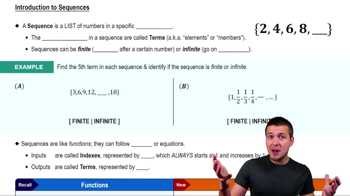
Limits of Sequences

The limit of a sequence describes the value that the terms of the sequence approach as the index goes to infinity. Understanding how to evaluate limits helps determine whether a sequence converges to a finite number or diverges.
Recommended video:
Guided course
8:22
Introduction to Sequences

Behavior of the Arctangent Function

The arctangent function, tan⁻¹(x), is continuous and bounded, approaching π/2 as x approaches infinity. Knowing this asymptotic behavior is crucial for analyzing sequences involving tan⁻¹(n) as n grows large.
Recommended video:
5:46
Graphs of Exponential Functions

Growth Rates and Dominant Terms

Comparing the growth rates of numerator and denominator helps determine the limit of a sequence. Since n grows without bound and tan⁻¹(n) approaches a constant, understanding which term dominates is key to finding the sequence's limit.
Recommended video:
04:16
Intro To Related Rates